Nanonets Health AI Agents

by Nanonets Health  · Based in United States → — Purpose-built AI agents for modern healthcare practices
dental-ai dermatology-ai mental-health-ai

Consumption-based model, pay per workflow block execution
Regulatory Status Disclosed

Overview

Nanonets Health AI Agents are designed to revolutionize front-end revenue cycle management (RCM) processes for healthcare providers. These specialized AI agents work 24/7 to automate critical administrative tasks, aiming to significantly reduce denied claims, improve cash flow, and free up valuable staff time so they can focus on patient care.

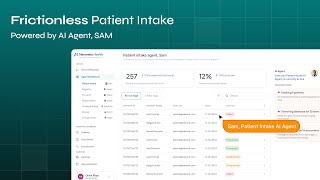
The suite includes several purpose-built agents: Sam for patient intake, Susan for eligibility & benefits verification, Steve for pre-authorization, Selena for scheduling, and Spencer for medical billing. These agents are capable of accurately reading and extracting information from over 20 types of patient documents, including insurance cards, lab reports, and patient forms, all while maintaining HIPAA and SOC 2 compliance.

Nanonets Health AI Agents seamlessly integrate with existing EHR and RCM systems, eliminating the need for practices to switch their core platforms. The AI is agentic, meaning it works on top of current systems and learns with every task, allowing for customizable workflows that adapt to each healthcare business’s unique processes. This adaptability ensures that the agents can be tailored to optimize specific operational challenges.

Practices utilizing Nanonets Health have reported substantial improvements, including a reduction in AR days, a significant drop in initial denial rates (from 12% to 7%), and faster claims processing. These efficiencies translate into considerable cost savings and improved financial health for hospitals and multi-specialty practice groups.

Reviewed by Pouyan Golshani, MD — Interventional Radiologist

Key Features

  • Purpose-built AI agents for RCM
  • 24/7 automated administrative tasks
  • Accurate document reading (20+ types)
  • Seamless integration with existing EHR/RCM systems
  • Customizable workflows and agent learning
  • Automated patient intake (Sam Agent)
  • Automated eligibility & benefits verification (Susan Agent)
  • Automated prior authorization (Steve Agent)
  • Automated appointment scheduling (Selena Agent)
  • Automated medical billing (Spencer Agent)

Use Cases

  • Automating patient referral and intake processes
  • Pre-verifying patient insurance eligibility
  • Coordinating and obtaining prior authorizations
  • Optimizing appointment scheduling and utilization
  • Streamlining medical billing to reduce DNFB
  • Reducing denied claims and improving cash flow

What Physicians Need to Know

Key Capabilities
Nanonets Health AI Agents automate administrative tasks across the revenue cycle. Key capabilities include reading and extracting data from over 20 types of patient documents (e.g., insurance cards, lab reports, patient forms). Specific AI agents handle patient intake (Sam), insurance eligibility and benefits verification (Susan), prior authorization (Steve), scheduling (Sarah), charge review (Sage), and AR and payment posting (Sean, Spencer). The platform can check insurance coverage, coordinate prior authorizations with payers, sync with EMRs for scheduling, and manage billing processes to reduce DNFB (Discharged Not Final Billed). It also automates referral processing, including email extraction, patient identification, and secure document attachment to EHRs.
Clinical Utility
The AI agents aim to free up administrative time and resources, allowing healthcare professionals to focus on patient care. Clinical utility includes reducing AR days, improving cash flow, decreasing initial denial rates, and cutting the average time to work denials. It also helps in reducing manual document handling time, achieving high accuracy in clinical and demographic data, and saving FTE bandwidth. The system can accelerate admission readiness for facilities, prevent revenue loss from verification errors, and secure authorizations faster, thereby reducing physician burnout and improving the patient experience.
Integration Options
Nanonets Health AI Agents are designed to work seamlessly with existing EHR and RCM systems, including AthenaHealth, eClinicalWorks, NextGen, MEDHOST, Epic, Cerner, and Salesforce HealthCloud. It offers real-time, two-way sync with common ERP and CRM solutions. Integrations extend to platforms like Gmail, Salesforce, Slack, Teams, databases, Google Drive, and Jira. The architecture is FHIR-native, enabling seamless integration for patient records, service requests, and clinical documentation.
Compliance Status
The platform is HIPAA compliant, SOC 2 certified, and adheres to ISO 27001 and GDPR controls. It ensures end-to-end encryption and secure PHI management, with a full audit trail built into every document processed. Data processing can be pinned to specific regions (US, EU, APAC) to ensure customer data remains within approved boundaries.
Pricing Model
Nanonets utilizes a 'pay-per-block run' pricing model, with no platform fees or seat licenses. Costs vary based on the complexity of the AI block: simple operations ($0.02/run), standard AI ($0.10/run), and complex AI (data extraction, generative AI) ($0.30/run). A typical workflow might involve 4-6 blocks per document. Volume discounts are available for 'Credits Accelerate' and 'Enterprise' plans. A free version with $200 in credits is offered to process thousands of documents before incurring costs. Plans include Starter ($0/month), Pro ($499/month), and custom Enterprise and On-premise options.
User Experience
Reviewers have found Nanonets to be easy to use, set up, and administer. The AI agents learn with every task and allow for customization of workflows with intuitive instructions. The system includes a human review step for coverage gaps, prior authorization failures, and low-confidence extractions, ensuring accuracy and providing context to human staff. The AI continuously improves over time, making it a reliable tool with minimal human intervention.
Support Quality
Nanonets offers a dedicated success team with healthcare specialists who provide continuous support throughout the automation journey. Reviewers have positively noted the quality of ongoing product support.
Implementation Complexity
The platform boasts rapid deployment, with implementation possible in under 30 days for immediate operational impact. It is designed to be plug-and-play with EHRs and often offers white-glove implementation, meaning an in-house tech team is not required for setup.
Evidence Base
Nanonets Health reports proven outcomes across 300+ healthcare organizations, from small practices to large systems. They offer a 3x ROI guarantee within 6 months across all healthcare specialties. Specific results include AR days decreasing from 54 to 42 days, initial denial rates dropping from 12% to 7%, and significant annual savings on outsourced coding. The platform's OCR-3 model is ranked #1 on the IDP Leaderboard, ahead of other prominent AI models, for accurate extraction.
Physician Tip

Leverage Nanonets Health AI Agents to offload high-volume, repetitive administrative tasks like patient intake, insurance verification, and prior authorizations. This can significantly reduce time spent on paperwork, minimize billing errors, and free up your staff to focus on direct patient care and complex cases. Pay attention to the human-in-the-loop features, where the AI flags low-confidence extractions for review, ensuring accuracy while still benefiting from automation. Utilize the customizability to tailor workflows to your practice's specific needs and integrate seamlessly with your existing EHR for a streamlined experience.

Nanonets Health offers extensive integration capabilities, designed to work on top of your current RCM and EHR systems rather than requiring a complete overhaul. This includes direct connections with major EHRs like Epic, Cerner, AthenaHealth, and NextGen, as well as broader enterprise systems like Salesforce, SAP, and Oracle. The platform also integrates with communication tools (Gmail, Slack, Teams) and document management systems (Google Drive), ensuring data flows smoothly across your entire operational ecosystem without custom middleware.

Details

Category Medical Billing & RCM, Patient Intake & Forms, Prior Authorization
Pricing Consumption-based model, pay per workflow block execution
  • No platform fees, no seat licenses
  • Simple operations: $0.02/run (formatting, routing, export)
  • Standard AI: $0.10/run (classification, validation)
  • Complex AI: $0.30/run (data extraction, generative AI)
  • A typical invoice processing workflow is under $2 per invoice end-to-end
  • A Pro plan is noted at $499/month when billed annually, but the primary model is usage-based
Free TrialUnknown
DeploymentCloud-native architecture on AWS with on-premise deployment options, integrates with existing EHR/RCM systems (e.g., AthenaHealth, eClinicalWorks, NextGen, MEDHOST).
API AvailableUnknown
Data ExportUnknown
TrainingUnknown
Target SizeSmall businesses to large enterprises, including Fortune 500 companies and regional hospitals.
Compliance
BAA AvailableUnknown AI-estimated
HIPAA CompliantUnknown AI-estimated
FDA Status No AI-estimated — N/A
SOC 2Unknown AI-estimated
GDPRUnknown AI-estimated
Integrations
EHR Unknown
Specialties Dental Ai, Dermatology Ai, Mental Health Ai, Radiology Imaging Ai

Social Proof

CustomersOver 10,000 customers worldwide, including approximately 34% of Fortune 500 companies.
Notable
unknown

Support & Reliability

Training ProvidedUnknown

What the Web Says

Nanonets Health AI Agents are designed to automate administrative processes in healthcare, focusing on patient access and operational efficiency. The platform utilizes AI-powered OCR and deep learning models to extract data from various documents, integrate with existing systems, and automate tasks like claims processing, patient intake, eligibility verification, prior authorization, and scheduling. Reviews highlight its high accuracy in data extraction and its ability to significantly reduce manual effort and processing time.

Overall: Positive

Strengths

  • High accuracy in data extraction, especially for complex documents.
  • Automates document-heavy processes, reducing manual data entry and saving time.
  • Customizable workflows and AI agents for specific healthcare needs.
  • Seamless integration with existing systems like EHRs, SAP, and Salesforce.
  • Responsive and helpful customer support.
  • Continuously learns and improves extraction accuracy over time.

Limitations

  • Initial setup and configuration can be substantial.
  • Pricing structure may be expensive or less flexible for smaller businesses.
  • Occasional bugs and variability in processing speed.
  • Some advanced features may require a learning curve or technical know-how.
  • Limited export options for extracted data.
  • Initial training time for AI models can be long.

Based on reviews from: G2, Elion, Capterra, Reddit, TechRadar, Gartner Peer Insights, Software Finder, YouTube, GetApp, Software Advice

Last updated: 2026-08-07

Ratings & Reviews

No reviews yet. Be the first to review this tool!

Rate Nanonets Health AI Agents

Clinical Value
Ease of Use
Integration
Support & Docs
Value for Money

Press & Coverage

Nanonets Health Blog
Nanonets Health and Stella Mental Health announce strategic partnership, featured in Becker's Behavioral Health
Nanonets Health and Stella Mental Health have partnered to transform administrative operations in behavioral health, a collaboration highlighted in Becker's Behavioral Health. The partnership aims to streamline processes using Nanonets Health's AI agents.
2026-03
Nanonets Health Blog
How to prevent Prior Authorization delays
This article from the Nanonets Health blog discusses how to prevent prior authorization delays, which often hinder treatment and increase costs. It suggests that AI agents can help streamline this process.
2026-03
Nanonets Health (Product Demo)
Nanonets Health - AI Agents for Healthcare RCM
This product demo explains how Nanonets Health AI agents can read complex patient documents, perform patient intake into EHRs, verify insurance across numerous payers, and schedule appointments. It highlights the arrival of agentic AI in healthcare RCM.
2025-03
YouTube (Nanonets Health)
Nanonets Health - Intro
This introductory video showcases Nanonets Health's AI agents designed to eliminate administrative work in healthcare, such as fixing patient information, handling faxes and forms, and managing phone calls. It emphasizes how AI can free up staff time for patient interaction.
2025-04
Nanonets Health
Agentic Intelligence for patient referrals processing - Nanonets Health
This page describes Nanonets Health's next-gen patient intake solutions, focusing on automated processing of referrals and clinical documentation with intelligent triage and routing. It highlights features like multi-patient identification and FHIR-native architecture.
unknown
Nanonets Health
Agentic Intelligence for Medical Billing - Nanonets Health
Nanonets Health offers agentic intelligence for medical billing, aiming for smart claims and maximum returns through real-time claim validation and automated policy compliance checks. It details how AI can reduce denial-related revenue loss.
unknown
Nanonets Health
Agentic Intelligence for Benefits Verification - Nanonets Health
This solution focuses on next-gen benefits verification, emphasizing speed and scale through automated insurance verification via direct payer phone calls and parallel processing. It aims for near-zero error rates in benefit verification.
unknown
YouTube (Nanonets)
Data Extraction Tutorial
This tutorial demonstrates how to extract data from policy documents or insurance receipts using Nanonets, showcasing the process of uploading documents, analyzing them, and exporting the extracted data.
2024-11

Videos

Product demos, reviews, and walkthroughs for Nanonets Health AI Agents.

View all on YouTube

Frequently Asked Questions

Nanonets Health AI Agents can automate numerous RCM tasks, including patient intake, eligibility and benefits verification, prior authorization checks, processing Explanation of Benefits (EOBs), claims generation, and denial management. These agents read various patient documents and integrate with existing EHR systems to streamline workflows and reduce manual data entry.
Nanonets Health AI Agents are designed to be HIPAA compliant, SOC 2 certified, and ISO 27001 compliant, ensuring robust data security and privacy. The platform incorporates end-to-end encryption, audit trails, and allows for data residency controls to keep patient information secure within approved boundaries.
Nanonets Health AI Agents utilize a usage-based pricing model, where costs are determined by the number of 'runs' or 'blocks' processed, with varying rates for simple, standard, and complex AI operations. They offer a free tier with initial credits and provide volume discounts for higher processing needs.
While Nanonets AI agents significantly improve efficiency and accuracy, human oversight remains critical for highly complex cases, nuanced clinical judgment, and interpreting ambiguous documentation. AI's effectiveness is also dependent on the quality and completeness of the input data, and human review is essential to prevent potential errors or 'hallucinations' in AI-generated outputs.
Yes, several alternatives exist for AI-powered RCM automation, including solutions like Doxis AI.dp, Rossum, Docsumo, and Amazon Textract. These platforms also offer document processing and data extraction capabilities, with differences in features, pricing models, and specific industry focus.
Nanonets Health AI Agents aim for high accuracy in tasks like eligibility verification, prior authorization, and claims generation, which can significantly reduce denial rates and accelerate reimbursement. Clients have reported substantial reductions in first-pass denials and improved cash flow by catching issues upstream before claim submission.
Nanonets Health AI Agents are designed for seamless integration with various EHR systems, including AthenaHealth, eClinicalWorks, NextGen, and others, often without requiring custom middleware. Some sources indicate rapid deployment, with implementation possible in under 30 days for immediate operational impact.

Related Tools

Rytsense AI Denial Management
Rytsense Technologies
Medical Billing & RCM
Rytsense AI Denial Management uses artificial intelligence to automate the identification, analysis, and appeal of denied healthcare claims, helping providers improve their revenue cycle.
UiPath Denial Management Solutions
UiPath
Medical Billing & RCM
UiPath Denial Management Solutions automate the identification, analysis, and appeal of denied claims to optimize healthcare revenue cycles.
MedCare MSO AI RCM Solutions
MedCare MSO
Documentation & Scribing
MedCare MSO provides AI-powered Revenue Cycle Management solutions including medical billing, coding, and rule engines to optimize financial processes for healthcare practices.
Staffingly Prior Authorization
Staffingly, Inc.
Documentation & Scribing
Staffingly provides AI-assisted automation and virtual assistants for healthcare practices, specializing in prior authorization, insurance verification, and revenue cycle management.
IVA (Intelligent Voice AI)
Intelligent Voice AI (IVAI)
Clinical Decision Support & Reference
IVA (Intelligent Voice AI) by IVAI offers ambient listening and automated medical scribing for healthcare, integrating with EHRs like Epic to enhance documentation, compliance, and operational efficiency.
Agentforce for Healthcare
Salesforce
Clinical Decision Support & Reference
Salesforce Agentforce for Healthcare leverages AI to optimize revenue cycle management and enhance operational efficiency for healthcare organizations, supporting care teams and integrating with major EHRs.

See all Medical Billing & RCM tools →

Suggest an Edit → | Last Verified: 2026-05-07 | First Added: 2026-05-07
AI Tool Finder
AI-powered search. Results may not be comprehensive.