AI-ECG Tracker vs PMcardio

AI Verdict
Choose AI-ECG Tracker if…
Choose AI-ECG Tracker if your organization requires a robust, on-premise AI-powered ECG auto-diagnosis system with high accuracy for a comprehensive range of cardiac abnormalities. This tool is ideal for hospitals and clinics needing a dedicated workstation for rapid, detailed ECG analysis and report generation, with the option for cloud services for remote diagnostic capabilities.
View AI-ECG Tracker →Choose PMcardio if…
Choose PMcardio if you need a flexible, mobile-first AI ECG interpretation platform for rapid, expert-level assessment of over 50 cardiac conditions at the point of care. This tool is well-suited for individual clinicians, emergency physicians, GPs, and paramedics who benefit from instant AI interpretations on a mobile app or web platform, with enterprise integration options for EHR/CVIS and EMS systems.
View PMcardio →When choosing between AI-ECG Tracker and PMcardio, physicians should consider their primary use case and deployment preferences. AI-ECG Tracker, developed by Shenzhen Carewell Electronics Co. (a subsidiary of Lepu Medical), excels in providing a comprehensive, high-accuracy (over 95%) auto-diagnosis for 104 ECG diagnostic classifications, including arrhythmias, myocardial ischemia, and infarction. Its strength lies in its robust on-premise AI-ECG Workstation with powerful GPU for rapid processing, making it ideal for institutions requiring a dedicated, high-throughput diagnostic system with optional cloud integration for remote services. Physicians in cardiology or emergency medicine who need a comprehensive, institution-wide solution for detailed ECG analysis and report generation would find AI-ECG Tracker particularly suitable.
In contrast, PMcardio offers a more agile and accessible AI platform, best suited for point-of-care interpretations across a broader range of healthcare professionals. It rapidly assesses over 50 cardiac conditions, including STEMI/OMI and reduced LVEF, with features like visual AI explainability (ECGxplain™) and culprit artery confidence scores. The key practical difference is PMcardio’s deployment as a mobile app and web platform, with enterprise integrations, making it highly adaptable for individual clinicians or smaller practices seeking instant, expert-level interpretations on the go. Its freemium model also allows for initial exploration before committing to a Pro Plan for unlimited analyses and advanced features. Physicians in emergency medicine, internal medicine, or those requiring immediate, actionable insights at the bedside, would likely benefit more from PMcardio’s flexibility and rapid diagnostic capabilities.
Reviewed by Pouyan Golshani, MD — Interventional Radiologist
Quick Comparison
| Feature | AI-ECG Tracker | PMcardio |
|---|---|---|
| Pricing | Not publicly available | Freemium |
| Deployment | On-premise (AI-ECG Workstation, Diagnostic Client) with optional cloud service (Lepu Nebula Cloud) for remote diagnostic services. | Mobile app (iOS and Android), Web platform, Enterprise integrations with EHR/CVIS and EMS systems |
| FDA Status | 1 AI-estimated | Pending AI-estimated |
Head-to-Head
AI-generated assessment across six dimensions based on each tool's documented features and compliance posture. Grounded in public data — not a substitute for hands-on evaluation.
Usability
PMcardioPMcardio offers a mobile app and web platform, making it highly accessible for individual clinicians and organizations. Its image recognition feature for printed ECGs further enhances ease of use. AI-ECG Tracker, while offering an optional cloud service, primarily relies on an on-premise workstation and diagnostic client, which may be less flexible for some users.
Clinical Value
PMcardioPMcardio has been clinically validated in over 25 studies, detecting over 50 cardiac conditions, including subtle occlusion myocardial infarction (OMI) and reduced Left Ventricular Ejection Fraction (LVEF). It also provides AI explainability with heatmaps, which can increase clinician trust and understanding. AI-ECG Tracker boasts high accuracy (over 95%) for common cardiac abnormalities and supports 16 cardiac classifications and 104 ECG diagnostic classifications, but lacks the extensive published validation and explainability features of PMcardio.
Pricing & Value
PMcardioPMcardio offers a freemium model with a free plan for 5 ECG analyses per month, allowing users to experience the tool before committing. Paid plans for individuals and teams are also transparently listed. AI-ECG Tracker's pricing is not publicly available, making it difficult to assess its value proposition without direct inquiry.
Enterprise Readiness
PMcardioPMcardio explicitly states enterprise integrations with EHR/CVIS and EMS systems, offers regional data residency options (US or EU), and provides comprehensive security and compliance certifications (SOC 2 Type II, ISO 27001, GDPR, HIPAA with BAA). AI-ECG Tracker offers on-premise deployment with an optional cloud service and mentions HIPAA compliance and BAA as 'likely' but not explicitly stated for the product, which might raise concerns for larger organizations.
Innovation
PMcardioPMcardio demonstrates stronger innovation with features like 'Queen of Hearts' for STEMI/OMI detection, 'LVsense' for reduced LVEF detection, and 'ECGxplain' for visual AI explainability. It also supports analysis of 50+ cardiac conditions. AI-ECG Tracker focuses on high accuracy for common abnormalities and rapid diagnosis, which are important but do not showcase the same level of innovative feature development.
Support & Docs
TieNeither tool provides extensive public details on their support and documentation. PMcardio mentions a Help Center and FAQ, which suggests some level of user support. AI-ECG Tracker's information is limited to product specifications, making a direct comparison of support and documentation difficult.
Feature-by-Feature
Detail beyond the Quick Comparison summary. For pricing, deployment, BAA, FDA, and HIPAA see the Overview tab.
| Feature | AI-ECG Tracker | PMcardio |
|---|---|---|
| Company | Shenzhen Carewell Electronics Co. (subsidiary of Lepu Medical) | Powerful Medical |
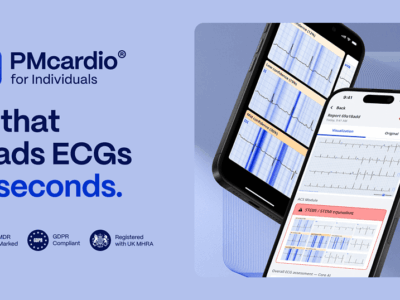
| Tagline | Forever Innovation Forever Care! | AI that reads ECGs in seconds |
| Key Detections/Diagnoses | 16 cardiac classifications and 104 ECG diagnostic classifications (including arrhythmias, ventricular hypertrophy, myocardial ischemia, myocardial infarction) | 50+ ECG findings (including STEMI/OMI, rhythms, reduced LVEF, conduction disorders), 36 core diagnoses (arrhythmias, conduction blocks, heart blocks, chamber hypertrophies) |
| AI Explainability | Not specified | ECGxplainu2122 - Visual AI Explainability with heatmaps |
| Speed of Diagnosis | Approximately 3 seconds | In seconds |
Videos
Demos, reviews, and walkthroughs featuring AI-ECG Tracker and PMcardio.