ChatGPT vs ZoeMD

AI Verdict
Choose ChatGPT if…
Choose ChatGPT if you need a versatile AI assistant for a broad range of tasks beyond just clinical decision support, such as generating patient education materials, summarizing research papers, or even assisting with administrative tasks. Its enterprise version is particularly well-suited for large healthcare systems requiring robust security, compliance, and custom workflow integrations.
View ChatGPT →Choose ZoeMD if…
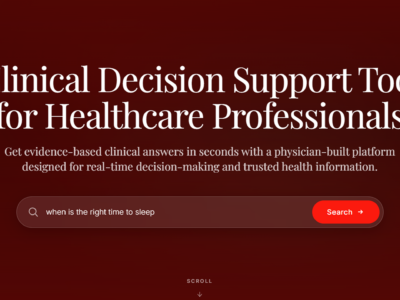
Choose ZoeMD if your primary need is evidence-based clinical decision support with direct citations and real-time assistance during patient encounters. It is ideal for healthcare professionals who require quick access to medical literature, smart differential diagnoses, and safety risk alerts across a wide array of specialties.
View ZoeMD →Reviewed by Pouyan Golshani, MD — Interventional Radiologist
Quick Comparison
Head-to-Head
AI-generated assessment across six dimensions based on each tool's documented features and compliance posture. Grounded in public data — not a substitute for hands-on evaluation.
Usability
ChatGPTChatGPT (Tool A) offers a highly intuitive conversational interface that is widely adopted across various user demographics, including a mobile app and voice interaction. While ZoeMD (Tool B) also offers multi-platform access, ChatGPT's general-purpose design and extensive user base suggest a more refined and broadly accessible user experience for a wider range of tasks beyond just clinical queries.
Clinical Value
ZoeMDZoeMD (Tool B) is explicitly designed as an evidence-based medical AI platform, offering features like a citation engine with direct links to sources, smart differential diagnosis, and safety risk alerts. While ChatGPT (Tool A) has a specialized healthcare version, its core strength lies in general-purpose text generation, whereas ZoeMD's features are directly tailored for clinical decision support and patient information, making it more valuable for specific clinical use cases.
Pricing & Value
ChatGPTChatGPT (Tool A) offers a clear freemium model with transparent pricing tiers for individuals, teams, and enterprises, including a free plan with access to the latest models. ZoeMD (Tool B) lists its 'Pro' plan at $0, which could be an introductory offer or placeholder, making its long-term pricing and value proposition less clear compared to ChatGPT's established and diverse pricing structure.
Enterprise Readiness
ChatGPTChatGPT (Tool A) explicitly offers an Enterprise plan with custom pricing, enterprise-grade security, compliance (including SOC 2), unlimited high-speed access, and dedicated support, along with a BAA and HIPAA compliance. ZoeMD (Tool B) is HIPAA compliant but does not detail enterprise-specific features like admin controls, dedicated support, or SOC 2 certification, making ChatGPT a more robust option for large healthcare organizations.
Innovation
ChatGPTChatGPT (Tool A) demonstrates broader innovation with features like DALL-E 3 image generation, advanced data analysis, web browsing, and custom GPTs for tailored workflows, alongside its core conversational AI. While ZoeMD (Tool B) innovates within clinical decision support, ChatGPT's continuous development across multiple AI modalities and applications positions it as a leader in general AI innovation that can be adapted to healthcare.
Support & Docs
ChatGPTChatGPT (Tool A) has a massive user base and, particularly for its Enterprise plan, offers dedicated support, implying extensive documentation and community resources. While ZoeMD (Tool B) mentions 'priority support' for its Pro plan, the sheer scale and maturity of OpenAI's ecosystem likely translate to more comprehensive support resources and documentation for its various offerings.
Feature-by-Feature
Detail beyond the Quick Comparison summary. For pricing, deployment, BAA, FDA, and HIPAA see the Overview tab.
| Feature | ChatGPT | ZoeMD |
|---|---|---|
| Name | ChatGPT | ZoeMD |
| Company | OpenAI | ZoeMD |
| Mobile App | Both | 1 |
| API Available | Yes | No |
| Target Size | All practice sizes from solo to enterprise for general use; Enterprise u2014 large health systems and hospitals for ChatGPT for Healthcare. | Any |
| Key Features | Human-like text generation and conversation, Summarization and translation of content, Code generation and debugging, Image creation and editing (DALL-E 3), Advanced data analysis from uploaded files, Web browsing for up-to-date information, Custom GPTs for tailored workflows, Voice input and interaction | Evidence-based search across 39M+ sources, Smart Differential Diagnosis, Citation Engine with direct links to sources, Safety Risk Alerts, Clinical Protocol Library, Clinical Summary generation, Patient information features, Multi-platform access (desktop, tablet, mobile) |
Videos
Demos, reviews, and walkthroughs featuring ChatGPT and ZoeMD.