Kore.ai
Overview
Kore.ai offers an agentic AI platform designed for healthcare, providing solutions for providers, payers, and life sciences organizations. The platform aims to automate workflows, reduce administrative burden, and improve care coordination by integrating with existing healthcare systems such as EHRs, RCM platforms, and payer portals.
- What it does: Kore.ai’s AI agents are built to handle end-to-end workflows autonomously, adapting to context and coordinating across disparate systems. This includes automating tasks like appointment scheduling, prescription management, revenue cycle management, and patient notifications and reminders. For payers, it supports member self-service for tasks such as ID card retrieval, health plan summaries, and claims status. In life sciences, it assists with medical affairs, providing real-time clinical and safety data and handling medical inquiries.
- Who it is for: The platform serves healthcare providers (hospitals, health systems), payers (insurance companies), and life sciences companies.
- How it fits a clinical or practice workflow: Kore.ai acts as a coordination and engagement layer, bridging gaps between various healthcare IT systems. It can automate high-volume administrative tasks, allowing clinical staff to focus on direct patient care. The AI agents can prepare for consultations by gathering and summarizing patient data from multiple sources, highlighting inconsistencies.
- Notable capabilities: Key features include multi-agent workflow orchestration, pre-built AI agents and templates for rapid deployment, and no-code design tools for customization. The platform is designed to be HIPAA-compliant and offers pre-built integrations with common EHR and healthcare platforms like Epic, Oracle Cerner, and NextGen. It also supports multilingual and 24/7 self-service options.
Reviewed by Pouyan Golshani, MD — Interventional Radiologist
Key Features
- Enterprise-grade agentic AI platform
- HIPAA-compliant AI agents
- Multi-agent orchestration
- No-code/low-code development tools
- Pre-built AI agents and templates (300+ for healthcare)
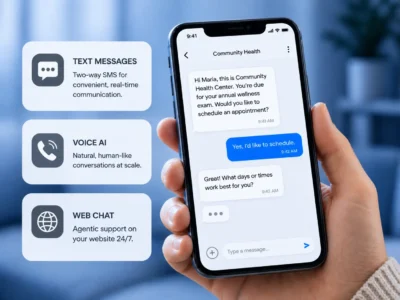
- Omnichannel deployment (30+ channels including voice, chat, email, SMS)
- Generative AI support (GALE)
- Advanced NLP and multilingual NLU support
- Real-time analytics and customizable dashboards
- Integrations with EHRs, CRMs, ERPs, and ticketing systems
Use Cases
- Automating appointment scheduling and reminders
- Handling patient inquiries and symptom checks
- Managing billing and claims processing
- Providing personalized financial assistance recommendations for members
- Delivering real-time clinical and safety data for life sciences
- Streamlining internal IT and HR support
What Physicians Need to Know
Leverage Kore.ai's AI agents to automate routine administrative tasks like appointment scheduling, prescription refills, and basic patient inquiries, freeing up clinical staff to focus on direct patient care. Utilize the multilingual support and health literacy adaptation features to effectively communicate with diverse patient populations. Integrate the symptom checker with Mediktor for initial patient triage and care navigation, but always emphasize that AI tools are for guidance and not a substitute for professional medical diagnosis. Employ the chronic disease management and medication adherence features to proactively engage patients, monitor their behavior, and improve adherence to treatment plans. Ensure proper integration with existing EHR/EMR systems to maintain a unified patient record and streamline workflows.
Kore.ai's Agent Platform is designed to integrate with existing healthcare systems, including EHR and EMR systems, RCM systems, and payer portals. It supports interoperability frameworks like HL7 FHIR. The platform is open and agnostic, allowing integration with various systems, including calendaring tools like Calendly. It also partners with specialized solutions like Mediktor for enhanced symptom checking and triage. Kore.ai emphasizes that its approach works within existing infrastructure rather than requiring replacement, acting as an intelligent coordination and engagement layer.
Details
| Category | Patient Engagement & Education |
| Pricing |
Paid
|
| Deployment | Cloud, Hybrid, On-premise |
| Compliance | |
| BAA Available | Unknown AI-estimated |
| HIPAA Compliant | Unknown AI-estimated |
| FDA Status | Unknown AI-estimated — unknown |
| Integrations | |
| EHR | Not specified |
| Specialties | Family Medicine, Hospital Medicine, Internal Medicine |
What the Web Says
Kore.ai's healthcare solutions are generally well-regarded for their ability to automate patient interactions, streamline administrative tasks, and provide personalized experiences. Reviewers highlight its potential to improve operational efficiency and patient engagement within healthcare settings, though some point to the complexity of initial setup and the need for ongoing refinement.
Overall: PositiveStrengths
- Automates routine patient inquiries and scheduling, freeing up staff.
- Improves patient engagement through personalized and accessible communication.
- Enhances operational efficiency by streamlining administrative workflows.
- Offers robust AI capabilities for understanding natural language.
- Scalable solution adaptable to various healthcare provider sizes.
- Integrates with existing healthcare systems (EHR/EMR).
Limitations
- Initial setup and integration can be complex and time-consuming.
- Requires significant customization to fully meet specific organizational needs.
- Potential for impersonal interactions if not carefully designed.
- Cost can be a barrier for smaller healthcare practices.
- Ongoing maintenance and optimization may require dedicated resources.
- Some users report a learning curve for advanced features.
Based on reviews from: G2, Capterra, Healthcare IT News, Reddit, TechCrunch, Physician reviews on industry forums
Last updated: 2026-08-24
Ratings & Reviews
No reviews yet. Be the first to review this tool!