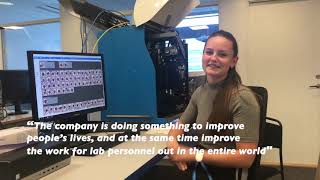
CellaVision DC-1

by CellaVision AB  · Based in Sweden → — Advancing laboratory workflow and diagnostic certainty through intelligent microscopy.
Hematology Laboratory Medicine Pathology

Not available publicly
Regulatory Status Disclosed

Overview

The CellaVision DC-1 is an advanced digital cell morphology analyzer designed to automate and simplify the process of performing blood cell differentials in low-volume hematology laboratories. It leverages high-speed robotics, digital imaging, and artificial intelligence (AI) to automatically locate, capture high-quality images, and pre-classify cells from stained blood smears. The system pre-classifies white blood cells (WBCs) into twelve categories and pre-characterizes red blood cell (RBC) morphology based on six categories, also offering functionality for platelet estimation. This automation significantly reduces manual steps and review time, leading to improved efficiency, quality, and standardization of results compared to traditional microscopy. The CellaVision DC-1 supports both stand-alone and networked installations, enabling remote review and collaboration among medical technologists, supervisors, and morphology experts, which is particularly beneficial for distributed laboratory networks. It is intended for in-vitro diagnostic use in clinical laboratories by trained operators.

Reviewed by Pouyan Golshani, MD — Interventional Radiologist

Key Features

  • Automated digital imaging of blood smears
  • AI-powered pre-classification of 12 WBC categories and 6 RBC morphologies
  • Automated platelet estimation
  • Standardized testing process for consistent accuracy
  • Reduces manual steps and review time for blood cell differentials
  • Supports remote review and collaboration among morphology experts
  • Designed specifically for low-volume hematology laboratories
  • Bi-directional LIS (Laboratory Information System) support (ASTM)
  • Local hard drive storage (up to 1,500 slides) with unlimited secondary storage options
  • Built-in quality control features including cell location accuracy test and smear check

Use Cases

  • Performing blood cell differentials in low-volume hematology laboratories
  • Modernizing and improving blood cell differential processes in small independent labs
  • Enabling remote review and expert consultation within distributed laboratory networks
  • Standardizing morphological assessments to reduce subjective interpretations
  • Improving workflow efficiency and turnaround times for blood smear analysis
  • Supporting training and proficiency development in cell morphology (with additional software)

What Physicians Need to Know

LIS/LIMS Integration
Supports bi-directional LIS integration via ASTM protocol and Ethernet 10/100 Mbps. Multiple CellaVision DM/DC analyzers can share a common database, facilitating networked laboratory environments.
Supported Assay Types
Primarily designed for blood cell differentials on peripheral blood smears. It performs differential counts of white blood cells (WBCs), characterizes red blood cell (RBC) morphology, and provides platelet estimation.
QC/QA Features
Includes a cell location accuracy test to verify hardware and stain quality, and a built-in smear check. A daily cell location test using a freshly stained slide with a normal WBC count is recommended for quality control.
Result Interpretation AI
Utilizes artificial intelligence (AI), specifically artificial neural networks (ANNs) or convolutional neural networks (CNNs), to automatically locate, capture, and pre-classify cells. It pre-classifies WBCs into twelve categories (e.g., segmented neutrophils, lymphocytes, blast cells) and non-WBCs into five categories (e.g., nucleated red cells, platelet clumps), and pre-characterizes RBC morphology based on six types (e.g., polychromasia, anisocytosis). The operator reviews and verifies the AI's suggested classifications.
Critical Value Alerts
While the system itself does not explicitly generate 'critical value alerts,' its remote review and collaboration features enable timely identification and escalation of critical findings by laboratory personnel to physicians, supporting established laboratory critical value protocols.
Instrument Interfaces
Features an integrated PC with Windows 10 embedded and runs CellaVision DM Software. It communicates via Ethernet 10/100 Mbps and accepts barcoded slides, with order IDs entered manually or using an optional barcode reader.
Reference Range Intelligence
Provides a standardized decision support framework through AI-driven pre-classification and pre-characterization of cells. It includes a built-in image library for comparing cells to reference images, aiding the operator in final verification against laboratory-defined reference ranges.
Turnaround Time Impact
Significantly improves efficiency and reduces turnaround time (TAT) by automating manual blood cell differential processes. Studies demonstrate reduced sample review times and up to a 94% improvement in TAT for referred smears in distributed laboratory networks, by eliminating physical slide transportation.
Physician Tip

The CellaVision DC-1 provides standardized, high-quality digital images and AI-assisted pre-classification of blood cells, which can enhance the accuracy and consistency of differential counts. For challenging cases, the system's remote review capabilities allow for rapid consultation with morphology experts or pathologists, potentially leading to faster diagnoses and treatment decisions. While the AI offers robust support for common cell types, physician oversight remains crucial, especially for rare or complex pathologies like certain leukemias, where the morphologist's final verification is the gold standard.

Seamless integration with existing Laboratory Information Systems (LIS) via bi-directional ASTM communication and Ethernet connectivity ensures efficient data flow and reduces manual entry errors. The ability for multiple CellaVision analyzers to share a database streamlines workflows in distributed laboratory networks, enabling remote review and collaborative diagnostics. This connectivity is key to maximizing the efficiency and quality benefits of digital morphology.

Details

Category Lab & Diagnostics, Pathology AI
Pricing Not available publicly — N/A
DeploymentOn-premise (analyzer with integrated PC), supports networked installation
Compliance
BAA AvailableUnknown AI-estimated
HIPAA CompliantUnknown AI-estimated
FDA Status 1 AI-estimated

The CellaVision DC-1, including the CellaVision DC-1 PPA, received FDA 510(k) clearance (K200595) on October 16, 2020. It is intended for in-vitro diagnostic use in clinical laboratories for differential count of white blood cells (WBC), characterization of red blood cell (RBC) morphology, and platelet estimation.

Integrations
EHR Not specified
Specialties Hematology, Laboratory Medicine, Pathology

What the Web Says

The CellaVision DC-1 is a digital cell imaging analyzer designed for low-volume and small satellite laboratories, automating and simplifying blood cell differentials. It utilizes AI-based image analysis for pre-classification of cells, which are then reviewed and verified by medical technologists. The system aims to improve efficiency, standardize results, and enable remote collaboration among healthcare professionals.

Overall: Mixed

Strengths

  • Reduces review time for routine films and overall turnaround time (TAT) for smears, especially in distributed laboratory networks.
  • Provides high-quality digital imaging and pre-classification of WBCs, RBCs, and platelets using AI, leading to more standardized and consistent results.
  • Enables remote review and collaboration with off-site colleagues, supervisors, and pathologists, improving communication and access to morphology experts.
  • Compact and easy to operate, making it suitable for smaller labs and as a backup or for specialty testing in larger networks.
  • Reduces the physical strain and fatigue associated with traditional manual microscopy.
  • Offers educational value through beautiful screenshots and the ability to save cases for sharing and training.

Limitations

  • Can struggle with body fluids, especially those with low WBC counts, leading to failed analyses and backlogs.
  • Limitations in RBC morphology identification, such as Howell-Jolly bodies, due to the inability to focus up and down on the slide.
  • Experienced morphologists may have trouble trusting the technology initially, leading to manual re-review which can negate efficiency gains.
  • May make unnecessary workload for cell verification in certain cell classes, particularly those with low positive predictive value (e.g., blasts, promyelocytes, myelocytes, metamyelocytes, plasma cells, nucleated red blood cells).
  • Less effective for classifying certain abnormal or rare cell types, such as those found in leukemia samples, where manual review remains the gold standard.
  • Some users report issues with inaccurate cell identification, such as eosinophils in the monocyte category or lymphocytes being called blasts, and overcalling certain features like polychromasia or artifacts.

Based on reviews from: Reddit, PubMed, Abacus dx, InPractise, Sysmex America, LabMedica, Tiger Medical, CellaVision (Official Website), ResearchGate, FDA

Last updated: 2026-07-20

Ratings & Reviews

No reviews yet. Be the first to review this tool!

Rate CellaVision DC-1

Clinical Value
Ease of Use
Integration
Support & Docs
Value for Money

Press & Coverage

CellaVision
CellaVisionu00ae receives CE marking according to IVDR Class C for CellaVisionu00ae Bone Marrow Aspirate Application
CellaVision's Bone Marrow Aspirate (BMA) Application for the CellaVision DC-1 instrument has received CE marking approval as a Class C product under the EU IVDR, allowing laboratories to analyze both bone marrow and peripheral blood samples side-by-side.
2025-12
CellaVision
CellaVisionu00ae receives CE marking for CellaVisionu00ae Bone Marrow Aspirate Application
The CellaVision BMA Application, running on the CellaVision DC-1, has received CE marking, enabling laboratories to analyze bone marrow and peripheral blood samples concurrently for more comprehensive assessments.
2025-12
RMIT University - Figshare
Novel comparison of CellaVision DC-1 and microscopic assessment of blood film morphology in paediatrics
This study compares the CellaVision DC-1 with microscopic assessment for blood film morphology in pediatrics, suggesting that while the DC-1 has benefits, manual microscopy remains faster and more accurate for pediatric samples, particularly for blast detection and RBC grading.
2025-10
Premier Health
July CompuNet Updates | Premier Health
CompuNet Clinical Laboratories completed the rollout of the CellaVision DC-1 with Epic Citrix remote database at Wayne HealthCare, automating and enhancing hematology peripheral blood smear reviews.
2025-07
Sysmex America
Sysmex America to Exhibit Portfolio of Solutions for the Lab of Tomorrow at ADLM 2025
Sysmex America will showcase the CellaVision DC-1 at ADLM 2025, highlighting its role as a revolutionary hematology analyzer designed to optimize WBC differential processes in low-volume labs through standardized classification criteria.
2025-07
American Journal of Clinical Pathology
critical analysis of CellaVision systems in the modern hematology laboratory | American Journal of Clinical Pathology | Oxford Academic
This article provides a critical analysis of CellaVision systems, including the DC-1, in modern hematology labs, noting their high accuracy for common cellular morphology but identifying challenges in detecting specific abnormalities like immature granulocytes and red blood cell agglutination.
2025-05
MDPI
Real-World Application of Digital Morphology Analyzers: Practical Issues and Challenges in Clinical Laboratories - MDPI
This peer-reviewed article discusses the real-world application of digital morphology analyzers, including the CellaVision DC-1, in clinical laboratories, addressing practical issues and challenges such as staining methods and the detection of abnormal cells.
2025-03
CAP TODAY
CellaVision bone marrow aspirate application gets CE mark - CAP TODAY
CellaVision's bone marrow aspirate application, running on the CellaVision DC-1, has received the CE mark as a class C product under the EU IVDR, utilizing AI-driven technology for automated cell location and preclassification.
2026-02

Videos

Product demos, reviews, and walkthroughs for CellaVision DC-1.

View all on YouTube

Frequently Asked Questions

The CellaVision DC-1 employs artificial intelligence to automatically locate, capture high-quality digital images, and pre-classify white blood cells (WBCs) into 12 categories and pre-characterize red blood cell (RBC) morphology into six types. This AI-driven pre-classification provides a standardized decision support framework for medical technologists, reducing subjective interpretations and improving efficiency.
The CellaVision DC-1 received FDA 510(k) clearance in October 2020, making it approved for in-vitro diagnostic use in the United States and Canada. It is intended for prescription use only and requires skilled operators trained in its use and blood cell recognition to verify or modify suggested classifications.
While highly accurate for common cellular morphology, the CellaVision DC-1's AI has limitations in detecting certain critical abnormalities like platelet clumping and blast cells, and may have variable sensitivity for less common WBC types or leukemia samples. It also requires human oversight, as the pre-classification may need adjustment, particularly for problematic or rare cells.
No, the CellaVision DC-1's AI acts as a decision support tool, pre-classifying cells for review and verification by a medical technologist or pathologist. Human oversight remains crucial, as a competent operator is required to verify or modify the AI's suggested classifications, especially for complex or abnormal cases.
Yes, other digital morphology analyzers exist, including other CellaVision systems like the DM96, DM1200, and DM9600, which are designed for higher throughput. Competitors such as Sysmex also offer digital morphology solutions like the DI-60.
The CellaVision DC-1 is designed for low-volume laboratories and is generally more affordable than larger systems, with reported prices ranging from approximately $32,000 to $45,000. Beyond the initial purchase, ongoing costs would include reagents, service contracts, and potential software updates.
No, the CellaVision DC-1 analyzers do not 'learn' on-site from individual lab classifications. The artificial neural networks are trained by CellaVision's morphological experts and are updated through software releases, ensuring standardized performance without local deviation.

Related Tools

LabLynx AI-Powered LIMS
LabLynx
Lab & Diagnostics
LabLynx AI-Powered LIMS integrates AI and Machine Learning into laboratory information management systems to automate complex analyses, predict outcomes, and optimize workflows for various lab settings. The platform offers LIMS, ELN, and Lab Automation suites, providing configurable and scalable solutions for diverse laboratory needs.
August AI
August AI
Lab & Diagnostics
August AI offers an AI-enabled telehealth platform with an AI health chatbot and virtual care services, including telehealth visits and prescription management. The company's AI chatbot is available globally for free, providing information and not medical advice. In the U.S., August AI offers August Care, a membership that provides clinical services, discounted labs, and quick prescriptions.
Allergios®
Allergios®
Lab & Diagnostics
Allergios® is developing an in-vitro diagnostic system that directly visualizes allergic responses in blood serum to provide unambiguous allergy diagnoses, starting with food allergies.
PNOĒ
PNOĒ
Endocrinology & Metabolic AI
PNOĒ is a science-backed cardiometabolic analyzer that performs comprehensive breath-based assessments to measure 23 biomarkers, including VO₂ max, resting metabolic rate (RMR), fat burn efficiency, and biological age. It delivers a 360° snapshot of an individual's physiology by analyzing how oxygen flows through the lungs, heart, and cells. The insights generated are used to personalize nutrition, exercise, and longevity plans.
Folklore Clinical Variant Interpretation
Helena Bioinformatics
Lab & Diagnostics
Folklore is a clinical variant interpretation platform for genetic laboratories and researchers that brings genomic annotation, ACMG/AMP classification, phenotype and inheritance evidence, literature, and structured reporting into one traceable workflow.
Insitro
Insitro
Drug Discovery & Research
Insitro combines automated cellular experiments with population-scale genetics to build Physical AI systems that reveal causal drivers of human disease and deliver targeted therapeutics.

See all Lab & Diagnostics tools →

More from CellaVision AB

Advanced RBC Application
CellaVision AB
Lab & Diagnostics
CellaVision Advanced RBC Application is an AI-powered software module that automates and standardizes the morphological examination of red blood cells, complementing peripheral blood smears for enhanced diagnostic efficiency in hematology labs.
CELLAVISION DM1200 WITH THE BODY FLUID APPLICTION
CELLAVISION AB
Lab & Diagnostics
The CellaVision DM1200 with the Body Fluid Application is an FDA-cleared automated digital cell morphology system that uses AI and robotics to simplify and standardize blood and body fluid differentials in hematology labs.
CELLAVISION DM96 AUTOMATIC HEMATOLOGY ANALYZER
CELLAVISION AB
Lab & Diagnostics
The CellaVision DM96 Automatic Hematology Analyzer was an automated image analysis system that revolutionized hematology laboratories by providing digital solutions for differential counting of white blood cells and characterization of red blood cells, leveraging AI for pre-classification and enhancing workflow efficiency.
CELLAVISION DM96 WITH THE BODY FLUID APPLICATION
CELLAVISION AB
Lab & Diagnostics
The CellaVision DM96 with the Body Fluid Application is an FDA-cleared automated digital morphology system that uses AI to analyze and pre-classify cells in blood and various body fluid samples, enhancing diagnostic efficiency and standardization in hematology laboratories.

View company profile →

Suggest an Edit → | Last Verified: 2026-04-20 | First Added: 2026-04-20
AI Tool Finder
AI-powered search. Results may not be comprehensive.