CellaVision DM Series

by CellaVision (part of Sysmex)  · Based in Sweden → — To advance laboratory workflow and diagnostic certainty through intelligent microscopy.
Hematology Laboratory Medicine Pathology

Contact vendor for pricing
Regulatory Status Disclosed

Overview

CellaVision DM Series are AI-powered digital morphology systems that automate and standardize the review of blood and body fluid smears, assisting in the classification of cells for hematology diagnostics. These solutions leverage artificial intelligence, deep learning, and digital imaging to standardize and simplify manual cell morphology analysis, improving diagnostic accuracy and efficiency in clinical laboratories. The systems are designed to automate the manual differential process, reducing time and resources for routine hematology testing while enhancing quality.

CellaVision offers various models (e.g., DC-1 for low-volume, DM1200 for mid-volume, DM9600 for high-volume labs) to suit different laboratory needs. They provide automated image capture and pre-classification of white blood cells (WBCs), pre-characterization of red blood cell (RBC) morphology, and platelet estimation. The systems integrate with Laboratory Information Systems (LIS) for seamless data transfer and offer remote review capabilities, facilitating collaboration and expert consultation across networked labs.

Reviewed by Pouyan Golshani, MD — Interventional Radiologist

Key Features

  • AI-assisted cell pre-classification (WBCs, RBCs, platelets)
  • Automated digital image capture from blood and body fluid smears
  • Standardized cell morphology analysis
  • Digital archiving of images and patient records
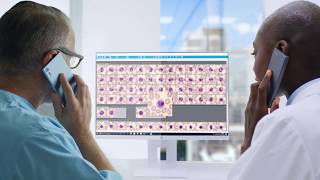
  • Remote review and collaboration capabilities
  • Bi-directional LIS (Laboratory Information System) support
  • Proficiency testing software for staff competency
  • Body Fluid Application for specialized fluid analysis
  • Advanced RBC Application for abnormal red blood cell samples
  • Scalable solutions for low, mid, and high-volume laboratories

Use Cases

  • Automating manual differential counts in hematology labs
  • Digital analysis of peripheral blood and body fluid samples
  • Improving diagnostic accuracy and efficiency in clinical settings
  • Staff training and competency assessment in cell morphology
  • Remote consultation and collaboration among medical professionals
  • Optimizing workflow and resource utilization in multi-site laboratory networks

What Physicians Need to Know

LIS/LIMS Integration
Offers bi-directional LIS/LIMS support via ASTM and Ethernet (10/100 Mbps), enabling seamless data exchange for patient demographics and order data. Multiple CellaVision DM analyzers can share a centralized database, and the system can integrate with existing hematology data management systems.
Supported Assay Types
Automates digital morphology analysis of peripheral blood smears and body fluid preparations. This includes differential counts of white blood cells (WBCs), characterization of red blood cell (RBC) morphology, and platelet estimation. Specific applications for Advanced RBC and Body Fluid analysis are available.
QC/QA Features
Includes cell location accuracy tests to verify hardware and stain quality, along with built-in smear checks and system self-tests. Customizable, on-board reference libraries and optional proficiency software are available to enhance staff training, ensure competency, and promote morphological standardization.
Result Interpretation AI
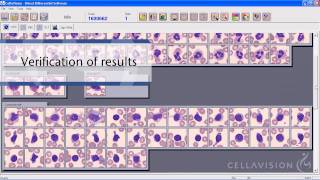
Leverages Artificial Neural Network technology and deep learning algorithms for automated pre-classification of WBC differentials and pre-characterization of RBC morphology. The system presents these pre-analyzed cells for review and verification by a medical technologist, ensuring validated and consistent performance as the AI does not 'learn' in the lab.
Critical Value Alerts
The CellaVision DM Series identifies and flags abnormal cells and morphological characteristics during its pre-classification process. This crucial data feeds into the overall laboratory workflow, enabling technologists to review potential critical findings and facilitate timely reporting through LIS integration.
Instrument Interfaces
Designed for integration into existing hematology workflows, supporting bi-directional LIS communication via ASTM and Ethernet (10/100 Mbps). It allows multiple CellaVision DM analyzers to share a common database and can interface with other hematology analyzers and data management systems.
Reference Range Intelligence
Enhances morphological standardization through customizable on-board reference libraries, which aids in consistent interpretation of cell morphology. The system is often used for blood samples flagged as abnormal by automated cell counters, providing detailed morphological context to support clinical decisions.
Turnaround Time Impact
Significantly reduces the time spent on manual smear review by automating cell location and pre-classification. This streamlines the workflow, facilitates faster slide reviews, and enables remote expert consultation, potentially leading to improved efficiency and quicker turnaround times, though human verification remains essential.
Microbiology ID Support
The CellaVision DM Series is primarily focused on hematology and body fluid cell morphology. While there is emerging research exploring its potential in parasitology (e.g., malaria detection), microbiology identification is not a core supported assay type for its primary application.
Physician Tip

The CellaVision DM Series provides high-quality digital images and AI-assisted pre-classification of blood and body fluid cells, which can significantly enhance diagnostic confidence and efficiency. Physicians can benefit from remote access to digital slides for rapid consultation, standardized morphological reporting, and improved collaboration with laboratory staff. The system's ability to highlight abnormal cells allows for focused review, supporting quicker clinical decisions, especially for critical cases. The customizable reference libraries also aid in consistent interpretation across different cases and clinicians.

The CellaVision DM Series offers robust bi-directional LIS/LIMS integration via industry-standard protocols like ASTM and Ethernet, ensuring seamless data flow and reducing manual transcription errors. Its architecture supports a networked environment, allowing multiple analyzers to share a central database and facilitating remote review capabilities. This connectivity is crucial for creating an automated and digital workflow, integrating with existing hematology systems, and enabling efficient data management within a laboratory or across a healthcare network.

Details

Category Lab & Diagnostics, Pathology AI
Pricing Contact vendor for pricing
  • Pricing is typically based on system configuration and laboratory volume; inquire with CellaVision or Sysmex sales representatives for detailed quotes
DeploymentOn-premise (hardware analyzers, system computer with Windows, server software for networked environments)
Compliance
BAA AvailableUnknown AI-estimated
HIPAA CompliantUnknown AI-estimated
FDA Status 1 AI-estimated

Multiple devices in the CellaVision DM Series (e.g., DM96, DM1200, DC-1) have received FDA 510(k) clearance for in-vitro diagnostic use. They are intended to automatically locate and present images of blood cells on peripheral blood smears and body fluid preparations, with a skilled operator identifying and verifying the suggested classifications.

Integrations
EHR Not specified
Specialties Hematology, Laboratory Medicine, Pathology

What the Web Says

The CellaVision DM Series is an automated digital cell morphology system designed to streamline and enhance the process of blood smear analysis in hematology laboratories. It aims to reduce the manual effort associated with traditional microscopy by automatically locating and pre-classifying cells, allowing for faster turnaround times and increased productivity. While generally seen as a valuable tool for efficiency, particularly in high-volume labs, its effectiveness can vary depending on the sample type and the experience of the user.

Overall: Mixed

Strengths

  • Increases efficiency and reduces turnaround time for routine films, especially in high-throughput labs.
  • Reduces eye fatigue, lower back stress, and wrist strain for laboratory staff by minimizing manual microscopic reviews.
  • Facilitates remote review, verification, and sign-off of cell differentials, enabling collaboration and expert consultation regardless of geographical location.
  • Provides high accuracy for pre-classification of common white blood cells like lymphocytes, monocytes, and neutrophils.
  • Excellent for educational purposes and sharing cases due to the ability to take and share high-quality screenshots.
  • Can be particularly helpful for finding cells in low white blood cell count samples.

Limitations

  • Struggles with body fluids, especially those with low WBC counts, often failing analysis or taking significant time.
  • Difficulty in accurately identifying certain red blood cell morphologies and inclusions, as the inability to focus up and down on a slide hinders detailed examination.
  • Experienced morphologists may have trouble trusting the system, leading to manual re-review that negates efficiency gains.
  • Steep learning curve for newer staff to differentiate normal from abnormal cells, particularly lymphocytes.
  • Pre-classification accuracy can be lower for certain cell types like eosinophils and basophils.
  • Cannot fully replace manual WBC differential counting; reclassification and slide review are still required for abnormal samples.

Based on reviews from: Reddit, PMC, Pathology Blogs, FDA, ResearchGate, MDPI

Last updated: 2026-08-11

Ratings & Reviews

No reviews yet. Be the first to review this tool!

Rate CellaVision DM Series

Clinical Value
Ease of Use
Integration
Support & Docs
Value for Money

Press & Coverage

Innolitics
AI/ML in Digital Pathology and the Software-as-an-IVD Paradigm: 2026 Snapshot
This article discusses the regulatory landscape for AI/ML-flagged devices in pathology, highlighting that CellaVision DM-series systems are considered modern trained-classifier systems and have been iterating on FDA approvals since 2001. Hematology and body-fluid analyzers, including CellaVision, dominate by volume in AI/ML authorizations.
2026-04
MDPI
Molecular Pathology, Artificial Intelligence, and New Technologies in Hematologic Diagnostics: Translational Opportunities and Practical Considerations
This peer-reviewed article highlights that CellaVision DM-series analyzers are widely used in hematology laboratories and have been evaluated in multiple studies, showing high concordance with manual microscopy and improving efficiency. The systems support remote review and consultation in routine hematology practice.
2026-03
PMC (PubMed Central)
Digital Medicine and Artificial Intelligence in Chronic Myeloid Leukemia: Current Applications, Challenges, and Future Directions
This review mentions the CellaVision DM Series as an automated blood smear analysis system with FDA 510(k) and CE-mark, widely used with over 95% accuracy on normal samples for differential counting and anomaly flagging. It is noted for its application in diagnostic hematology.
2026-02
ASCLS
Hematology Diagnostics Market Advances with AI, Automation, and Digitalization
This article notes that digital imaging systems like the CellaVision DM-series are key advancements in automated peripheral smear analysis, capturing detailed blood smear images for automated classification. These systems enhance diagnostic accuracy and efficiency in hematological diagnostics.
2025-12
MDPI
The Diagnostic Performance of the Cellavision DC-1 Digital Morphology Analyser on Leukaemia Samples
This peer-reviewed study references the CellaVision DM-series, particularly the DM-96, for its promising diagnostic ability in detecting blast cells and its high correlation and accuracy in pre-classifying leukocytes in samples with abnormalities. It suggests the DM-series is suitable for laboratories with heavy workloads.
2025-08
Scribd (Kalorama Information)
The IVD Market in 2025: $113 Billion and Growing
This market insight report states that CellaVision's DM series of cell imaging and analysis systems, introduced in 2000, are major products in the IVD market. Major hematology vendors market these digital cell analysis systems alongside their high-end instruments.
2025-09
ResearchGate
Performance of the new MCu201080 automated digital cell morphology analyser in detection of normal and abnormal blood cells: Comparison with the CellaVision DM9600
This peer-reviewed article compares the performance of a new automated digital cell morphology analyzer with the CellaVision DM9600, indicating the DM9600's established role in detecting normal and abnormal blood cells. The CellaVision DM-series has shown promising diagnostic ability for blast cells and high accuracy for leukocyte pre-classification.
2023-09
Scribd (Kalorama Information)
AI in IVD: Market Insights 2020
This report from 2020 highlights the CellaVision DM series as major products in cell imaging and analysis systems, introduced in 2000. The CellaVision DM1200 system is noted for its automatic microscopy and advanced image processing to pre-classify blood cells.
2020-04

Videos

Product demos, reviews, and walkthroughs for CellaVision DM Series.

View all on YouTube

Frequently Asked Questions

The CellaVision DM Series primarily automates the differential white blood cell count through preclassification and assesses red blood cell morphology using the Advanced RBC Application. It also provides functionality for platelet estimation and can analyze body fluid preparations. These capabilities streamline routine analysis and support high-volume diagnostic workflows.
The system enhances workflow by reducing manual microscopy, decreasing eyestrain for laboratory staff, and improving consistency in results. It facilitates digital archiving of images, enables remote review by specialists, and provides valuable tools for training and collaboration among laboratory personnel. This automation allows medical technologists to focus more on critical abnormal cells.
While highly effective, the CellaVision DM Series requires oversight by skilled laboratory staff and cannot fully replace manual review, especially for abnormal samples. Specific limitations include challenges with detecting critical abnormalities like platelet clumping and blast cells, and less accurate estimation of platelets and red cell morphology in some cases. Manual review is recommended for samples from newborns, leukemia patients, suspected pathological cells, suspected schistocytes, malaria screening, RBC agglutinates, and platelet aggregates.
Yes, CellaVision operates an ISO 13485 and MDSAP-certified business, ensuring product safety and effectiveness. The DM Series devices comply with European regulations such as IVDR (EU) 2017/746 and the Machinery Directive 2006/42/EC. The CellaVision DM96, for instance, has also received FDA 510(k) clearance for diagnostic use in the United States.
Several alternative digital morphology systems exist, including the Sysmex DI-60 (which utilizes the CellaVision platform), Vision Hema, EasyCell, Nextslide, and Cobas m511. While CellaVision is considered a market leader, some alternatives like the Mindray MC-series have shown potentially better accuracy in pre-classification of blast cells and other pathological cells compared to CellaVision's lower-throughput models.
Implementing a CellaVision DM Series system represents a significant capital investment for a laboratory. For example, a CellaVision DM1200 has been listed for over $200,000, indicating these are high-value pieces of equipment. Exact pricing can vary based on the specific model (e.g., DM1200, DM9600, or DC-1), configuration, and regional market.
CellaVision systems generally characterize common cellular morphology with a high degree of accuracy, particularly for neutrophils, lymphocytes, and common red blood cell changes. While pre-classification accuracy is high for many cell types, it can vary for pathological smears, showing weaker correlations for blasts, giant platelets, basophils, and eosinophils. Ultimately, skilled laboratory staff are essential for reviewing and verifying the pre-classified results, especially in complex cases.

Related Tools

LabLynx AI-Powered LIMS
LabLynx
Lab & Diagnostics
LabLynx AI-Powered LIMS integrates AI and Machine Learning into laboratory information management systems to automate complex analyses, predict outcomes, and optimize workflows for various lab settings. The platform offers LIMS, ELN, and Lab Automation suites, providing configurable and scalable solutions for diverse laboratory needs.
August AI
August AI
Lab & Diagnostics
August AI offers an AI-enabled telehealth platform with an AI health chatbot and virtual care services, including telehealth visits and prescription management. The company's AI chatbot is available globally for free, providing information and not medical advice. In the U.S., August AI offers August Care, a membership that provides clinical services, discounted labs, and quick prescriptions.
Allergios®
Allergios®
Lab & Diagnostics
Allergios® is developing an in-vitro diagnostic system that directly visualizes allergic responses in blood serum to provide unambiguous allergy diagnoses, starting with food allergies.
PNOĒ
PNOĒ
Endocrinology & Metabolic AI
PNOĒ is a science-backed cardiometabolic analyzer that performs comprehensive breath-based assessments to measure 23 biomarkers, including VO₂ max, resting metabolic rate (RMR), fat burn efficiency, and biological age. It delivers a 360° snapshot of an individual's physiology by analyzing how oxygen flows through the lungs, heart, and cells. The insights generated are used to personalize nutrition, exercise, and longevity plans.
Folklore Clinical Variant Interpretation
Helena Bioinformatics
Lab & Diagnostics
Folklore is a clinical variant interpretation platform for genetic laboratories and researchers that brings genomic annotation, ACMG/AMP classification, phenotype and inheritance evidence, literature, and structured reporting into one traceable workflow.
Insitro
Insitro
Drug Discovery & Research
Insitro combines automated cellular experiments with population-scale genetics to build Physical AI systems that reveal causal drivers of human disease and deliver targeted therapeutics.

See all Lab & Diagnostics tools →

Suggest an Edit → | Last Verified: 2026-05-12 | First Added: 2026-05-12
AI Tool Finder
AI-powered search. Results may not be comprehensive.