
Cranial Navigation
Overview
Brainlab Cranial Navigation is an advanced image-guided surgery (IGS) system designed for precision in neurosurgical and craniofacial procedures. It integrates software and hardware to provide surgeons with real-time, high-resolution imaging and accurate tracking of surgical instruments. The system supports comprehensive preoperative planning and intraoperative guidance, aiming to minimize trauma, reduce operating times, and enhance patient outcomes. Key functionalities include various patient image registration methods, instrument calibration using optical tracking technology, and advanced visualization tools. It is fully DICOM-based and can run in parallel with Brainlab Elements applications for instant synchronization and updated navigated image sets. The system incorporates AI/ML features for tasks like landmark detection and centering of views, demonstrating equivalent or higher performance compared to conventional methods. Brainlab Cranial Navigation is part of a broader ecosystem of digital medical technologies, including microscope integration with augmented reality overlays and ultrasound navigation, to provide a comprehensive solution for complex cranial cases.
Reviewed by Pouyan Golshani, MD — Interventional Radiologist
Key Features
- Precise Guidance with Unique Surface Matching Algorithm (Softouchu00ae, Z-touchu00ae)
- Minimized Trauma & Brain Retraction
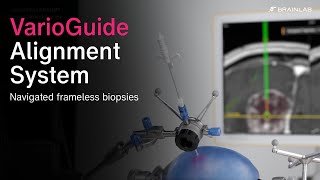
- Frameless Biopsy and Epilepsy Surgery Support
- Rapid Patient Registration Process
- Magnified Tool Tip Verification
- Shorter Surgical Operating Time & Smaller Craniotomies
- Consumable-Less Solution with Reusable Instruments
- Advanced Diffusion Tensor Imaging (DTI) for Surgical Planning
- High-resolution 3D Visualization for detailed brain mapping
- Real-time Instrument Tracking for enhanced surgical precision
- User-friendly interface with customizable settings
- Integration with preoperative MRI and CT scans
- Automatic Segmentation of skin, bone, cortical vessels and cerebrum
- 3D Preview of lesion and critical structures before opening the skull
- Virtual Scalpel for craniotomy simulation
- Approach Planning in 3D
- Vascular Navigation (Angio) for identifying veins and nidus objects
- Ultrasound Navigation for real-time intraoperative imaging and brain shift compensation
- Robotic Biopsy Alignment (with Cirq alignment software)
- Microscope Navigation with Augmented Reality (AR) overlays
- AI/ML features for landmark detection and centering of views
Use Cases
- Cranial Resection (tumors, lesions, skull-base)
- AVM Resection
- Craniofacial Procedures (including cranial and midfacial bones)
- Orbital cavity reconstruction procedures
- Removal of foreign objects
- Cranial biopsies and puncture of abscesses
- Craniotomies and Craniectomies
- Shunt placement, including pediatric shunt placement
- Epilepsy surgery
What Physicians Need to Know
Leverage the automatic segmentation and 3D preview capabilities for optimal craniotomy planning and to visualize lesions and critical structures before incision. Utilize the Cranial Navigation Angio for enhanced orientation and clinical context from 3D anatomical data, especially when dealing with vascular structures. Integrate real-time intraoperative ultrasound to compensate for brain shift and assess resection progress, ensuring maximum safe tumor or lesion removal. The system's ability to overlay real-time data directly into the microscope ocular or exoscopic view allows for continuous focus on the surgical field, improving precision and ergonomics. Employ the automated registration features with intraoperative imaging (iMRI, iCT, Loop-X) to maintain an optimized workflow and verify surgical plans in real-time.
Brainlab Cranial Navigation is designed for seamless integration with various imaging modalities, including MRI, CT, angiography, and ultrasound. It supports all major neurosurgery microscopes, offering positional tracking and augmented reality overlays directly into the surgeon's line of sight. The system integrates with other Brainlab platforms like Elements for comprehensive surgical planning, Curveu00ae Navigation, Kicku00ae, Loop-Xu00ae Mobile Imaging Robot for intraoperative imaging, and Buzzu00ae Digital O.R. It also features Automatic Image Registration (AIR) for intraoperative CT and cone-beam CT images, and a recent integration with Fujifilm's ARIETTA Precision ultrasound system for streamlined setup and real-time intraoperative ultrasound insights.
Details
| Category | Neurology AI, Radiology & Imaging AI, Surgical AI |
| Pricing | Contact vendor |
| Deployment | On-premise (dedicated navigation platforms like Curve® and Kick®) |
| Compliance | |
| BAA Available | Unknown AI-estimated |
| HIPAA Compliant | Unknown AI-estimated |
| FDA Status |
1 AI-estimated FDA 510(k) clearance K223288 was granted on July 21, 2023, for 'Neurological Stereotaxic Instrument'. The clearance covers 'Cranial Navigation, Navigation Software Cranial, Navigation Software Craniofacial, Cranial EM System, Automatic Registration iMRI'. It is an image-guided surgery system for navigated treatments in cranial surgery, including craniofacial indications, utilizing optical tracking technology and AI/ML features for landmark detection and centering of views. |
| Integrations | |
| EHR | Not specified |
| Specialties | Neurosurgery, Radiology |
Ratings & Reviews
No reviews yet. Be the first to review this tool!
Rate Cranial Navigation
Press & Coverage
Videos
Product demos, reviews, and walkthroughs for Cranial Navigation.
How The Neurosurgeons Navigate Through The Brain?

No FAQs available yet for this tool.