OpenEvidence vs CompliantChatGPT

AI Verdict
Choose OpenEvidence if…
Choose OpenEvidence if your primary need is immediate, evidence-based answers to complex clinical questions, directly sourced from peer-reviewed medical literature and official guidelines. It's ideal for physicians who require transparent, referenced support for high-stakes decisions at the point of care, especially given its official partnerships with leading medical journals and organizations.
View OpenEvidence →Choose CompliantChatGPT if…
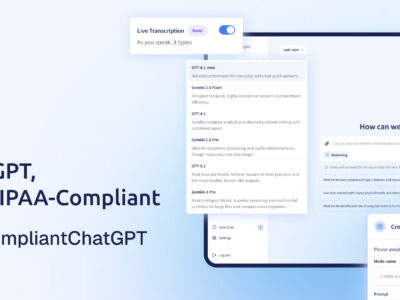
Choose CompliantChatGPT if you require a versatile, HIPAA-compliant conversational AI for a broader range of clinical tasks beyond just evidence retrieval, such as AI scribing, drafting various clinical notes (e.g., SOAP notes), and assisting with lab analysis and differential diagnoses. It's well-suited for healthcare professionals seeking a secure, AI-powered assistant to streamline documentation and enhance general clinical productivity across multiple specialties.
View CompliantChatGPT →Reviewed by Pouyan Golshani, MD — Interventional Radiologist
Quick Comparison
| Feature | OpenEvidence | CompliantChatGPT |
|---|---|---|
| Pricing | Free | Starts at $19.99 usd per user/month |
| Deployment | Cloud-based (web application) and mobile applications | SaaS, Desktop (macOS), Mobile (iOS, Android) |
Head-to-Head
AI-generated assessment across six dimensions based on each tool's documented features and compliance posture. Grounded in public data — not a substitute for hands-on evaluation.
Usability
OpenEvidenceOpenEvidence offers a clean and responsive user interface across web and native mobile applications (iOS and Android), with features like Home Screen widgets and Control Center shortcuts for quick access. It also recently launched a hands-free voice AI feature, enhancing ease of use at the point of care. CompliantChatGPT also offers web, desktop (macOS), and mobile apps, and users have reported significant reductions in documentation time. However, OpenEvidence's widespread adoption by over 757,000 verified physicians and positive user reviews highlighting its speed and ease of application suggest a slightly superior user experience.
Clinical Value
OpenEvidenceOpenEvidence excels in providing evidence-based clinical decision support, grounding its answers in peer-reviewed medical literature from reputable sources like NEJM, JAMA, NCCN, and Cochrane, with transparent sourcing. It has demonstrated high accuracy on USMLE-type questions and offers features like 'Deep Consult' for comprehensive literature synthesis. While CompliantChatGPT assists with documentation, differential diagnoses, and lab analysis, its core function relies on anonymizing PHI before sending it to general AI models, which may introduce limitations compared to OpenEvidence's direct integration with curated medical knowledge.
Pricing & Value
OpenEvidenceOpenEvidence is free for verified U.S. healthcare professionals, making it a highly accessible and cost-effective solution for individual clinicians. Its funding model relies on transparent pharmaceutical advertising and enterprise subscriptions, which allows it to offer its core services without direct cost to the end-user. CompliantChatGPT, while offering a 7-day free trial, has a tiered subscription model starting at $19.99 per user/month, which, while competitive, does not match the free offering of OpenEvidence for individual users.
Enterprise Readiness
OpenEvidenceOpenEvidence demonstrates strong enterprise readiness through its established EHR integrations, such as with Epic at Mount Sinai Health System, and its enterprise pricing models for larger organizations. It also offers features like 'OpenEvidence Visits' for integrated documentation workflows and supports administrative automation. CompliantChatGPT offers custom enterprise pricing with SSO, governance, and custom features/integrations, and provides APIs for automation. However, OpenEvidence's broader adoption in over 10,000 hospitals and care centers in the U.S. and its partnerships with major medical organizations suggest a more mature enterprise footprint.
Innovation
TieBoth tools demonstrate innovation in different aspects. OpenEvidence innovates by providing AI-powered, referenced answers directly from peer-reviewed literature, and has introduced features like hands-free voice AI and 'Deep Consult' for comprehensive research. CompliantChatGPT's innovation lies in its HIPAA-compliant PHI anonymization technology, allowing healthcare professionals to safely use general AI models for various tasks, and its multi-language support. Given their distinct yet impactful approaches to leveraging AI in healthcare, neither tool clearly surpasses the other in overall innovation.
Support & Docs
OpenEvidenceOpenEvidence provides a range of support and documentation resources, including tutorials, customer support, training sessions, and real-time chatbot support. While detailed technical documentation is not publicly available, it encourages developers to explore API capabilities. CompliantChatGPT's documentation is less explicitly detailed in the provided information, though it does offer dedicated customer support for its Enterprise plan. OpenEvidence's comprehensive approach to user onboarding and ongoing support gives it a slight edge.
Feature-by-Feature
Detail beyond the Quick Comparison summary. For pricing, deployment, BAA, FDA, and HIPAA see the Overview tab.
| Feature | OpenEvidence | CompliantChatGPT |
|---|---|---|
| Name | OpenEvidence | CompliantChatGPT |
| Company | OpenEvidence | Light-it |
| Tagline | America's Official Medical Knowledge Platform | ChatGPT, but HIPAA Compliant |
| Free Trial | Not specified | 7-day free trial, no credit card required. |
| Key Features (Clinical Decision Support) | AI-powered natural language question answering for clinical queries; Answers grounded in peer-reviewed medical evidence (NEJM, JAMA, NCCN, Cochrane, PubMed); Fully referenced answers with transparent sourcing to primary studies and guidelines; Clinical decision support at the point of care for high-stakes decisions. | Differential diagnosis assistance; Lab analysis and interpretation. |
| Key Features (Documentation & Scribing) | OpenEvidence Visits: transcribe patient visits and auto-generate structured medical notes; Real-time clinical decision support integrated into documentation workflows; Integrates with Electronic Health Record (EHR) systems like Epic. | AI scribing; Clinical documentation generation; SOAP note drafting; Session summarization; EHR-ready workflows; HIPAA-compliant PHI anonymization. |
Videos
Demos, reviews, and walkthroughs featuring OpenEvidence and CompliantChatGPT.
Frequently Asked Questions
More Comparisons
More matchups featuring OpenEvidence or CompliantChatGPT
Backers
Who funded each tool's parent company.