OpenEvidence vs ZoeMD

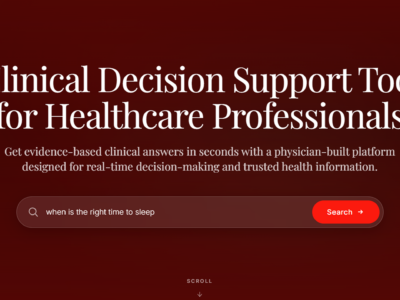
AI Verdict
Choose OpenEvidence if…
Choose OpenEvidence if you are a verified U.S. healthcare professional seeking a free, comprehensive AI-powered clinical decision support platform deeply integrated with leading medical institutions. It is ideal for those who require immediate, referenced answers from peer-reviewed literature and desire tools for transcribing patient visits and auto-generating structured medical notes directly within their workflow, especially with EHR integration like Epic.
View OpenEvidence →Choose ZoeMD if…
Choose ZoeMD if you need a freemium evidence-based medical AI platform offering real-time decision-making support across a very broad range of specialties. It is particularly well-suited for users who value features like Smart Differential Diagnosis, a robust Citation Engine with direct links to sources, and Safety Risk Alerts, making it useful for diverse clinical scenarios and in-depth research.
View ZoeMD →When choosing between OpenEvidence and ZoeMD, physicians should consider their primary needs regarding clinical decision support and documentation. OpenEvidence excels as a comprehensive platform for immediate, referenced answers from a curated set of high-impact peer-reviewed medical literature, including direct partnerships with organizations like NEJM and JAMA. Its key practical difference lies in its integrated documentation features, such as transcribing patient visits and auto-generating structured medical notes, alongside real-time clinical decision support within these workflows. This makes it particularly well-suited for physicians seeking to streamline their documentation process while simultaneously accessing evidence-based guidance at the point of care.
ZoeMD, on the other hand, offers a broader search across over 39 million sources and provides features like Smart Differential Diagnosis and Safety Risk Alerts, catering to a wider range of specialties. While both offer cited clinical answers, ZoeMD’s emphasis appears to be on extensive evidence-based search and diagnostic assistance, making it valuable for physicians who prioritize a vast knowledge base and tools to aid in complex diagnostic processes. The practical difference here is ZoeMD’s wider source base and specialized diagnostic tools versus OpenEvidence’s focus on high-tier journal partnerships and integrated documentation. Physicians heavily involved in specialties requiring extensive literature review or complex differential diagnoses might lean towards ZoeMD, especially given its freemium model for basic access.
Ultimately, a physician prioritizing seamless integration of evidence-based answers with their clinical documentation workflow, especially within specialties like Family Medicine, Hospital Medicine, or Internal Medicine, would likely find OpenEvidence more beneficial. Conversely, a physician needing a broader evidence search, specialized diagnostic tools, and support across a wider array of medical specialties might find ZoeMD to be the more suitable choice, particularly if they are comfortable with its freemium model and extensive source base.
Reviewed by Pouyan Golshani, MD — Interventional Radiologist
Quick Comparison
| Feature | OpenEvidence | ZoeMD |
|---|---|---|
| Pricing | Free | Freemium |
| Deployment | Cloud-based (web application) and mobile applications | Cloud |
| FDA Status | Unknown | Not applicable AI-estimated |
| HIPAA | Unknown | Yes AI-estimated |
Head-to-Head
AI-generated assessment across six dimensions based on each tool's documented features and compliance posture. Grounded in public data — not a substitute for hands-on evaluation.
Usability
OpenEvidenceOpenEvidence offers a clean and responsive user interface across web and mobile applications, with features like Quick Consult for rapid answers and Deep Consult for more thorough literature synthesis. It also provides hands-free voice AI and features like 'OpenEvidence Visits' for integrated documentation workflows, including transcription and note drafting assistance. ZoeMD also offers multi-platform access and natural language querying, but specific user experience details beyond general positive testimonials are less detailed in the provided information.
Clinical Value
OpenEvidenceOpenEvidence is an official AI partner of major medical journals like NEJM and JAMA, and its answers are grounded in peer-reviewed medical evidence with transparent sourcing. It has demonstrated high scores on USMLE-type questions, including a perfect 100% score, and offers features like real-time clinical decision support and auto-generation of structured medical notes. While ZoeMD also provides evidence-based answers from a large source base and smart differential diagnosis, OpenEvidence's strong partnerships and documented high performance on medical examinations give it an edge in established clinical validation.
Pricing & Value
OpenEvidenceOpenEvidence is free for verified U.S. healthcare professionals, making it highly accessible and a strong value proposition. While it is ad-supported, this model has driven significant adoption. ZoeMD offers a freemium model, with a free tier and a 'Pro' tier listed at $0, which may be an introductory offer, but its long-term pricing strategy for advanced features is less clear.
Enterprise Readiness
OpenEvidenceOpenEvidence has established enterprise pricing models for EHR integration and data insights subscriptions, and it integrates with EHR systems like Epic, with documented embedding at Mount Sinai Health System. It also offers features like 'OpenEvidence Visits' for documentation workflows and has HIPAA compliance and BAA availability. ZoeMD mentions HIPAA compliance and multi-platform access, but lacks specific details on enterprise integrations or established enterprise client base beyond general customer count.
Innovation
OpenEvidenceOpenEvidence demonstrates strong innovation with its AI-powered natural language question answering, fully referenced answers, and the 'OpenEvidence Visits' feature for transcribing patient visits and auto-generating notes with real-time decision support. Recent updates include voice AI, coding intelligence, and customizable note generation. ZoeMD also utilizes AI for evidence-based search and smart differential diagnosis, but OpenEvidence's continuous development of integrated workflow tools and advanced features like voice mode showcases a more aggressive innovation trajectory.
Support & Docs
TieBoth tools offer support and documentation. OpenEvidence provides tutorials, customer support, training sessions, and real-time chatbot support, with developer resources for API integration. ZoeMD also has a user manual, training videos, FAQs, and direct contact support options. Without more specific comparative details on the depth, responsiveness, or user satisfaction with their respective support and documentation, it's difficult to definitively pick a winner.
Feature-by-Feature
Detail beyond the Quick Comparison summary. For pricing, deployment, BAA, FDA, and HIPAA see the Overview tab.
| Feature | OpenEvidence | ZoeMD |
|---|---|---|
| Name | OpenEvidence | ZoeMD |
| Tagline | America's Official Medical Knowledge Platform | Clinical Decision Support Tool for Healthcare Professionals |
| Key Features (AI-powered Q&A) | AI-powered natural language question answering for clinical queries; Answers grounded in peer-reviewed medical evidence (NEJM, JAMA, NCCN, Cochrane, PubMed); Fully referenced answers with transparent sourcing | Evidence-based search across 39M+ sources; Citation Engine with direct links to sources |
| Key Features (Documentation/Scribing) | OpenEvidence Visits: transcribe patient visits and auto-generate structured medical notes; Real-time clinical decision support integrated into documentation workflows | Clinical Summary generation; Patient information features |
| EHR Integration | Integrates with Electronic Health Record (EHR) systems like Epic | Not specified |
| Official Partnerships | Official AI Partner of The New England Journal of Medicine, JAMA, NCCN, and Cochrane | Not specified |
| Specialties | Family Medicine, Hospital Medicine, Internal Medicine | cardiology-ai, chiropractic, critical-medicine, dental-ai, dermatology-ai, Emergency Medicine, endocrinology-metabolic-ai, Family Medicine, gastroenterology-ai, General Surgery, Hospital Medicine, Infectious Disease, Internal Medicine, Nephrology, obstetrics-gynecology-ai, orthopedic-surgery, Otolaryngology (ENT), pain-management, Pediatrics, physiotherapy, podiatry, Psychiatry, Pulmonology, Rheumatology, Urology |
Videos
Demos, reviews, and walkthroughs featuring OpenEvidence and ZoeMD.