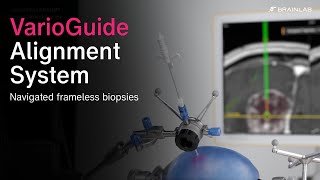
Cranial Navigation

by Brainlab AG  · Based in Germany →Simplicity in Neuronavigation. Efficiently combining decisive aspects of neurosurgery.
Neurosurgery Radiology

Contact vendor
Regulatory Status Disclosed

Overview

Brainlab Cranial Navigation is an advanced image-guided surgery (IGS) system designed for precision in neurosurgical and craniofacial procedures. It integrates software and hardware to provide surgeons with real-time, high-resolution imaging and accurate tracking of surgical instruments. The system supports comprehensive preoperative planning and intraoperative guidance, aiming to minimize trauma, reduce operating times, and enhance patient outcomes. Key functionalities include various patient image registration methods, instrument calibration using optical tracking technology, and advanced visualization tools. It is fully DICOM-based and can run in parallel with Brainlab Elements applications for instant synchronization and updated navigated image sets. The system incorporates AI/ML features for tasks like landmark detection and centering of views, demonstrating equivalent or higher performance compared to conventional methods. Brainlab Cranial Navigation is part of a broader ecosystem of digital medical technologies, including microscope integration with augmented reality overlays and ultrasound navigation, to provide a comprehensive solution for complex cranial cases.

Reviewed by Pouyan Golshani, MD — Interventional Radiologist

Key Features

  • Precise Guidance with Unique Surface Matching Algorithm (Softouchu00ae, Z-touchu00ae)
  • Minimized Trauma & Brain Retraction
  • Frameless Biopsy and Epilepsy Surgery Support
  • Rapid Patient Registration Process
  • Magnified Tool Tip Verification
  • Shorter Surgical Operating Time & Smaller Craniotomies
  • Consumable-Less Solution with Reusable Instruments
  • Advanced Diffusion Tensor Imaging (DTI) for Surgical Planning
  • High-resolution 3D Visualization for detailed brain mapping
  • Real-time Instrument Tracking for enhanced surgical precision
  • User-friendly interface with customizable settings
  • Integration with preoperative MRI and CT scans
  • Automatic Segmentation of skin, bone, cortical vessels and cerebrum
  • 3D Preview of lesion and critical structures before opening the skull
  • Virtual Scalpel for craniotomy simulation
  • Approach Planning in 3D
  • Vascular Navigation (Angio) for identifying veins and nidus objects
  • Ultrasound Navigation for real-time intraoperative imaging and brain shift compensation
  • Robotic Biopsy Alignment (with Cirq alignment software)
  • Microscope Navigation with Augmented Reality (AR) overlays
  • AI/ML features for landmark detection and centering of views

Use Cases

  • Cranial Resection (tumors, lesions, skull-base)
  • AVM Resection
  • Craniofacial Procedures (including cranial and midfacial bones)
  • Orbital cavity reconstruction procedures
  • Removal of foreign objects
  • Cranial biopsies and puncture of abscesses
  • Craniotomies and Craniectomies
  • Shunt placement, including pediatric shunt placement
  • Epilepsy surgery

What Physicians Need to Know

Brain MRI/CT Analysis
Brainlab Cranial Navigation utilizes MRI and CT data for 3D reconstruction, enabling automatic segmentation of critical structures such as skin, bone, cortical vessels, and cerebrum. It facilitates detailed anatomical visualization and tumor localization through the fusion of CT and MRI images. The 'Elements' applications support interactive and automatic segmentation for state-of-the-art planning of image-guided surgery.
Large Vessel Occlusion (LVO) Guidance
While not for acute detection, Cranial Navigation Angio assists surgeons in identifying feeding and draining vessels and locating a nidus object during surgical planning for conditions like AVMs. This is achieved through co-registered angiographies and neurovascular contouring, enhancing anatomical 3D data and improving orientation for surgical intervention.
Triage Prioritization Speed
The system streamlines surgical workflows through automated functions like data selection and layout composition, reducing screen interaction and enhancing user-friendliness. Time-saving registration methods, such as surface matching with Softouchu00ae or Z-touchu00ae, allow for quick patient registration without headsets or markers, potentially reducing overall procedure time.
Physician Tip

Leverage the automatic segmentation and 3D preview capabilities for optimal craniotomy planning and to visualize lesions and critical structures before incision. Utilize the Cranial Navigation Angio for enhanced orientation and clinical context from 3D anatomical data, especially when dealing with vascular structures. Integrate real-time intraoperative ultrasound to compensate for brain shift and assess resection progress, ensuring maximum safe tumor or lesion removal. The system's ability to overlay real-time data directly into the microscope ocular or exoscopic view allows for continuous focus on the surgical field, improving precision and ergonomics. Employ the automated registration features with intraoperative imaging (iMRI, iCT, Loop-X) to maintain an optimized workflow and verify surgical plans in real-time.

Brainlab Cranial Navigation is designed for seamless integration with various imaging modalities, including MRI, CT, angiography, and ultrasound. It supports all major neurosurgery microscopes, offering positional tracking and augmented reality overlays directly into the surgeon's line of sight. The system integrates with other Brainlab platforms like Elements for comprehensive surgical planning, Curveu00ae Navigation, Kicku00ae, Loop-Xu00ae Mobile Imaging Robot for intraoperative imaging, and Buzzu00ae Digital O.R. It also features Automatic Image Registration (AIR) for intraoperative CT and cone-beam CT images, and a recent integration with Fujifilm's ARIETTA Precision ultrasound system for streamlined setup and real-time intraoperative ultrasound insights.

Details

Category Neurology AI, Radiology & Imaging AI, Surgical AI
Pricing Contact vendor
DeploymentOn-premise (dedicated navigation platforms like Curve® and Kick®)
Compliance
BAA AvailableUnknown AI-estimated
HIPAA CompliantUnknown AI-estimated
FDA Status 1 AI-estimated

FDA 510(k) clearance K223288 was granted on July 21, 2023, for 'Neurological Stereotaxic Instrument'. The clearance covers 'Cranial Navigation, Navigation Software Cranial, Navigation Software Craniofacial, Cranial EM System, Automatic Registration iMRI'. It is an image-guided surgery system for navigated treatments in cranial surgery, including craniofacial indications, utilizing optical tracking technology and AI/ML features for landmark detection and centering of views.

Integrations
EHR Not specified
Specialties Neurosurgery, Radiology

Ratings & Reviews

No reviews yet. Be the first to review this tool!

Rate Cranial Navigation

Clinical Value
Ease of Use
Integration
Support & Docs
Value for Money

Press & Coverage

Brainlab Press Release
Brainlab and Fujifilm Integrate Cutting-Edge Technology, Offering Advanced Capabilities to Neurosurgery Clinicians in the U.S.
Brainlab and FUJIFILM Healthcare Americas Corporation announced a partnership where Brainlab will be the exclusive U.S. distributor of the ARIETTA Precision Ultrasound for neurosurgery, integrating it with Brainlab's surgical navigation systems to provide real-time intraoperative insights.
2024-04
Frontiers in Surgery
Neuronavigation in glioma resection: current applications, challenges, and clinical outcomes
This systematic review explores the integration of neuronavigation with intraoperative imaging to optimize glioma resection, highlighting how advanced technology improves surgical outcomes but may not always reduce operative times.
2024-08
Medical Science Monitor
High-Accuracy Neuro-Navigation with Computer Vision for Frameless Registration and Real-Time Tracking
This study introduces the Zeta Cranial Navigation System, a novel device utilizing computer vision for real-time, frameless registration and continuous patient tracking in neurosurgery, addressing limitations of traditional systems for awake and non-immobilized patients.
2023-12
Brainlab Press Release
Brainlab Announces FDA 510(k) Clearance and US Launch of Spine Mixed Reality Navigation
Brainlab received FDA 510(k) clearance and launched its Spine Mixed Reality Navigation in the U.S., an advanced surgical navigation solution that combines optical navigation with mixed reality for enhanced visualization during pedicle screw placement in spine surgery.
2025-09
CURE Uganda News
CURE Uganda Acquires Revolutionary Brainlab Neuro-Navigation System
CURE Children's Hospital of Uganda has acquired a Brainlab Neuro Navigation System, becoming the first hospital in Uganda to implement this advanced technology for greater precision in pediatric neurosurgery, including tumor resections and epilepsy surgeries.
2025-04
Brainlab News
Brainlab at DLD Health: Advancing precision in Brain-Computer Interface implantation
Brainlab CEO Rainer Birkenbach discussed the critical role of precise surgical navigation in Brain-Computer Interface (BCI) implantation at DLD Health, highlighting the company's involvement in advancing this revolutionary field.
2026-06
Medical Science Monitor
Impact of BrainLab VectorVision Infrared-Based Neuronavigation on Surgical Outcomes in Intracranial Meningioma Patients: A Retrospective Study
A retrospective study analyzed 80 patients undergoing meningioma surgery between 2013 and 2023, concluding that while neuronavigation increased surgery duration, it allowed for smaller incisions and craniotomies.
2023-01
FDA 510(k) Clearance
Cranial Navigation, Navigation Software Cranial, Navigation Software Craniofacial, Cranial EM System, Automatic Registration iMRI
The FDA granted 510(k) clearance for Brainlab's Cranial Navigation system, including its Cranial EM System and Automatic Registration iMRI accessory, expanding its indications to include craniofacial surgery.
2023-07

Videos

Product demos, reviews, and walkthroughs for Cranial Navigation.

View all on YouTube

No FAQs available yet for this tool.

Related Tools

DETECT-ME/CFS project
ME/CFS Research Foundation (Sponsor: Federal Ministry of Health (BMG))
Clinical Decision Support & Reference
The DETECT-ME/CFS project is developing an AI-supported clinical decision support system to improve the rapid and reliable diagnosis of Myalgic Encephalomyelitis/Chronic Fatigue Syndrome.
Neurotrack
Neurotrack
Clinical Decision Support & Reference
Neurotrack is a cognitive care enablement platform that provides clinically validated, FDA class II device assessments and care planning support to identify and manage cognitive decline and dementia earlier and with greater accuracy.
LesionQuant
CorTechs Labs
Neurology AI
LesionQuant, an FDA-approved AI product by CorTechs Labs, is particularly useful for patients with multiple sclerosis. It provides brain structure data and quantifies the number, size, and location of lesions, comparing them to prior studies.
ExcelsiusGPS
Globus Medical
Neurology AI
ExcelsiusGPS™ is the first and only robotic navigation platform on the market that offers a comprehensive approach to spine and cranial procedures, from start to finish. The system enables repeatable and accurate trajectory alignment and navigation for placing screws, interbody implants, and cranial instruments.
Onera SleepMap
Onera B.V.
Neurology AI
Onera SleepMap is an AI-powered sleep analysis software that processes polysomnography data, part of Onera Health's innovative patch-based system for at-home and in-lab sleep studies. The system aims to make clinical-grade sleep diagnostics more accessible and user-friendly, providing comprehensive data comparable to traditional in-lab PSG.
JLK-NCCT
JLK-NCCT
Clinical Decision Support & Reference
JLK-NCCT is an AI software designed to assist in the analysis of non-contrast CT brain scans for the detection of acute ischemic stroke.

See all Neurology AI tools →

More from Brainlab AG

(Elements) Cranial SRS
Brainlab AG
Neurology AI
Elements Cranial SRS by Brainlab AG is an advanced software for stereotactic radiosurgery planning in cranial cases, offering automated, indication-specific treatment plans with 3D visualization and advanced optimization algorithms for precise and efficient dose delivery.
(Elements) Dose Review
Brainlab AG
Oncology AI
Brainlab Elements Dose Review is an AI-powered software for radiation therapy planning, offering detailed dose analysis, plan comparison, and segmentation for various anatomical regions as part of the broader Brainlab Elements suite.
(Elements) Retreatment Review
Brainlab AG
Neurology AI
Elements Retreatment Review is an AI-powered software by Brainlab AG that streamlines retreatment planning for multiple brain metastases by integrating prior treatment data, new scans, and AI-driven tumor segmentation for optimal decision-making.
(Elements) Spine SRS
Brainlab AG
Oncology AI
Brainlab Elements Spine SRS is an advanced, AI-powered software for highly automated and precise treatment planning of spinal metastases using stereotactic radiosurgery (SRS) and stereotactic body radiation therapy (SBRT). It offers features like spinal curvature correction, automatic target delineation, and optimized dose calculation for superior spinal cord sparing.

View company profile →

Suggest an Edit → | Last Verified: 2026-04-18 | First Added: 2026-04-18
AI Tool Finder
AI-powered search. Results may not be comprehensive.