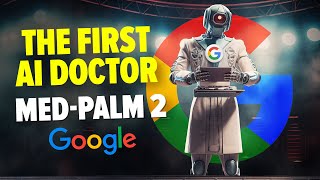
Google Med-PaLM 2

by Google  · Based in United States →A large language model specifically built for healthcare, fine-tuned with medical data to assist with clinical decision support, summarization, and medical Q&A.
Critical Care Internal Medicine Radiology

Contact for pricing

Overview

Google Med-PaLM 2 is an advanced large language model (LLM) specifically designed and fine-tuned for the healthcare domain. It builds upon the powerful PaLM 2 architecture, incorporating extensive medical knowledge from journals, textbooks, and clinical trials. Med-PaLM 2 has demonstrated expert-level performance on medical licensing exams, achieving 86.5% accuracy on USMLE-style questions. It is capable of understanding and generating natural language in a medical context, performing reasoning and inference based on medical knowledge.

Beyond text-based capabilities, Med-PaLM 2 is evolving with multimodal functionalities, allowing it to synthesize and communicate information from medical images such as X-rays, mammograms, and CT scans, alongside clinical data, patient histories, genetic information, and medical literature. This enables it to offer more comprehensive insights into complex medical conditions. Med-PaLM 2 is one of the research models that powers MedLM, a family of foundation models fine-tuned for the healthcare industry, available to Google Cloud customers.

Reviewed by Pouyan Golshani, MD — Interventional Radiologist

Key Features

  • Expert-level medical question answering (86.5% accuracy on USMLE-style questions)
  • Advanced clinical reasoning capabilities
  • Comprehensive medical knowledge base
  • Multi-step problem solving
  • Medical literature synthesis and analysis
  • Multimodal data analysis (interprets X-rays, mammograms, CT scans, clinical data, patient histories, genetic information)
  • Evidence-based recommendations
  • Continuous learning and updates
  • Bias mitigation and content filtering
  • Supports multiple languages (PaLM 2, the base model, is trained on over 100 languages)

Use Cases

  • Clinical decision support: assisting healthcare professionals with reasoning, differential diagnosis, and treatment recommendations
  • Medical education: supporting students and professionals with exam preparation, case studies, and knowledge assessment
  • Medical research: accelerating literature analysis, hypothesis generation, and data interpretation
  • Early disease detection
  • Precision medicine: developing personalized treatment plans
  • Summarizing documentation and insights from internal datasets and scientific knowledge

What Physicians Need to Know

Evidence Base
Med-PaLM 2 is built on Google's PaLM 2 architecture and fine-tuned for medical applications. It has been trained on an extensive corpus of medical texts, including medical journals, textbooks, clinical notes, patient records, and scientific papers. [2, 3, 9, 12] The model also processes and analyzes multimodal data, such as medical images (X-rays, MRIs, CT scans), clinical data, patient histories, and genetic information. [1, 2, 15] Its training involved MultiMedBench, a multimodal medical dataset with over 1 million examples across 14 tasks including question answering, report generation, and classification. [1]
Clinical Validation Studies
Med-PaLM 2 achieved 86.5% accuracy on USMLE-style questions (MedQA dataset), representing a 19% improvement over its predecessor and reaching an 'expert' doctor level. [1, 3, 5, 7, 8, 11, 13, 14, 16, 20] In a pairwise study of 1,066 consumer medical questions, physicians preferred Med-PaLM 2's long-form answers over physician-generated answers across eight of nine clinical utility axes, including scientific factuality, precision, medical consensus, and reasoning. [5, 7, 18, 20] Clinicians also preferred Med-PaLM 2 reports over radiologists' reports in up to 40.5% of cases in a direct comparison of 246 retrospective chest X-rays. [1, 7]
Drug Interaction Checking
Med-PaLM 2's capabilities include providing personalized treatment recommendations and assisting with precision medicine decisions by analyzing various data points, including patient history and genetic information. [1, 12, 13] While not explicitly stated as 'drug interaction checking,' its comprehensive medical knowledge and reasoning capabilities suggest it could contribute to safer medication management. [4, 9]
Differential Diagnosis Support
Med-PaLM 2 offers advanced clinical reasoning and diagnosis support. [4] Studies have shown Med-PaLM 2's ability to generate differential diagnoses, outperforming human doctors in diagnosing real-life scenarios with a 35.4% accuracy compared to 13.8% for doctors using the LLM. [6]
Guideline Update Frequency
Med-PaLM 2 is continuously improved with the latest medical knowledge and clinical reasoning capabilities. [4] Google's commitment to ongoing research and development in medical AI suggests regular updates to its underlying knowledge base. [16]
Clinical Workflow Integration
Med-PaLM 2 is available through Google's MedLM API and Google Cloud's Vertex AI platform for approved healthcare applications and select healthcare partnerships. [4, 7, 12, 21] It is being piloted by organizations like HCA Healthcare and Mayo Clinic to augment existing workflows, support clinicians in documentation, streamline nurse hand-offs, and assist with medical note creation from physician-patient conversations. [8, 17, 19, 21] The model is designed to be integrated into healthcare applications, research platforms, or educational systems. [4]
Decision Audit Trail
While not explicitly detailed, Google Cloud platforms are designed to be flexible, including data and model lineage capabilities. [10] This suggests that, as a Google Cloud offering, Med-PaLM 2 integrations would likely support audit trails for decisions made within its framework, especially given the critical nature of healthcare data and regulatory compliance (e.g., HIPAA). [4, 10, 13]
Physician Tip

Med-PaLM 2 is a powerful AI assistant, not a replacement for clinical judgment. Always validate its outputs with your professional expertise. Leverage its multimodal data analysis for comprehensive insights, especially in complex cases or for early disease detection. Utilize its differential diagnosis support as a valuable second opinion. When integrated into your workflow, it can significantly reduce administrative burdens like documentation. Remember that while the model is continuously updated, staying abreast of the latest medical guidelines remains crucial. Be mindful of data privacy and security protocols when integrating and using AI tools in your practice.

Med-PaLM 2 is accessible via Google's MedLM API and Google Cloud's Vertex AI platform. It is designed for integration into existing healthcare applications, research platforms, and educational systems. Current integrations and pilots include major healthcare organizations like HCA Healthcare and Mayo Clinic, focusing on areas such as clinical documentation and medical image analysis. Google emphasizes client control over encrypted data and adherence to HIPAA compliance for medical use cases.

Details

Category Clinical Decision Support & Reference, Documentation & Scribing, Medical Education & Training
Pricing Contact for pricing
  • Med-PaLM 2 is available through Google's MedLM API and select healthcare partnerships
  • Access requires approval for medical use cases
  • It is currently available to a limited number of Google Cloud customers
DeploymentCloud-based (Google Cloud Vertex AI)
Compliance
BAA Available Yes AI-estimated
HIPAA Compliant Yes AI-estimated
FDA Status Unknown AI-estimated

Google emphasizes responsible AI deployment in healthcare settings and compliance with healthcare regulations, including obtaining necessary approvals for medical AI deployment. The FDA has an action plan for AI/ML Software as a Medical Device.

Integrations
EHR Not specified
Specialties Critical Care, Internal Medicine, Radiology

What the Web Says

Google Med-PaLM 2 is a large language model (LLM) specifically designed and fine-tuned for the medical domain, aiming to provide high-quality answers to medical questions and assist healthcare professionals. It has demonstrated expert-level performance on medical licensing exams, such as the USMLE, achieving an accuracy of 86.5% on the MedQA dataset. Physicians have shown a preference for Med-PaLM 2's long-form answers over those provided by other physicians in several key areas of clinical utility.

Overall: Positive

Strengths

  • Achieves expert-level performance on medical licensing exams (e.g., USMLE-style questions with 86.5% accuracy).
  • Physicians preferred Med-PaLM 2's long-form answers to those from human physicians on eight out of nine clinical utility axes.
  • Demonstrates strong performance across various medical question-answering datasets, including MedMCQA and PubMedQA.
  • Capable of generating accurate, helpful, and detailed long-form answers to consumer health questions.
  • Shows a low risk of harm (90.6%) in adversarial testing datasets and high alignment with scientific consensus (92.6%).
  • Can be expanded to include multimodal capabilities, such as analyzing X-rays and mammograms, and responding to follow-up questions.

Limitations

  • Still in early stages of development and refinement, with ongoing efforts to improve accuracy.
  • Not yet widely available to the public; limited access for select Google Cloud customers for testing.
  • Some clinicians have reservations about its use in daily medical operations, citing concerns about hallucinations and lack of real-world clinical testing.
  • One dimension where model-generated answers were not as favorable as physician-generated answers was the inclusion of inaccurate or irrelevant information.
  • Does not yet fully demonstrate true clinical reasoning, but rather mimics it based on natural language processing.
  • Should not replace professional medical judgment and is designed to support, not replace, healthcare professionals.

Based on reviews from: Google Research, Reddit, Becker's Hospital Review, Quantumrun, Medium, Sik-Ho Tsang (Medium), Healthcare Dive, MedPage Today, RepuGen, Google Cloud Blog, Dr7.ai, Inclusion Cloud, Sergei Polevikov (Medium), MedTech Dive, Artificial Intelligence Learning, PMC, Packt

Last updated: 2026-08-25

Ratings & Reviews

No reviews yet. Be the first to review this tool!

Rate Google Med-PaLM 2

Clinical Value
Ease of Use
Integration
Support & Docs
Value for Money

Press & Coverage

Google Cloud Blog
Sharing Google's Med-PaLM 2 medical large language model, or LLM | Google Cloud Blog
Google announced limited access to Med-PaLM 2 for select Google Cloud customers to test its capabilities in answering complex medical questions and exploring use cases. The model achieved expert-level performance on USMLE-style questions, reaching over 85% accuracy.
2023-04
Epocrates
What is Google's Med-PaLM 2 and what can it do for healthcare?
Med-PaLM 2 demonstrates multimodal capabilities, including interpreting medical images and achieving 86.5% on the USMLE exam. Google is exploring its potential to bring medical expertise to remote areas and is conducting adversarial testing for ethical alignment.
2023-05
ExtremeTech
The Mayo Clinic Is Bringing Google's AI Chatbot to Medical Facilities | Extremetech
The Mayo Clinic has been testing Google's Med-PaLM 2 since April to assist clinicians with tasks like health record retrieval and answering routine medical questions. The AI chatbot is designed to handle medical information and encrypt patient data for privacy.
2023-07
Fox Business
Hospitals begin test driving Google's medical AI chatbot: report - Fox Business
Several hospitals, including the Mayo Clinic, are test-driving Google's Med-PaLM 2, an AI chatbot trained on medical licensing exams to offer better medical advice. Google anticipates its value in areas with limited access to doctors.
2023-07
PCMag
Google's Medical Chatbot Is Being Tested in Hospitals | PCMag
Med-PaLM 2, a version of Google's PaLM 2 AI model, is being tested at the Mayo Clinic and other locations to answer medical questions, summarize documents, and organize health data. Patient data is encrypted, and customers retain control.
2023-07
U.S. Senator Mark Warner
Warner Urges Google to Protect Patients and Ensure Ethical Deployment of Health Care AI
Senator Mark Warner expressed concerns to Google CEO Sundar Pichai regarding Med-PaLM 2's deployment, citing reports of inaccuracies and calling for increased transparency, patient privacy, and ethical guardrails.
2023-08
Deepgram
Medical AI Models Transforming Healthcare | 2026 Guide - Deepgram
Med-PaLM 2 is highlighted as a significant benchmark achievement in medical AI, with 86.5% accuracy on the MedQA benchmark, but it remains a research tool without FDA regulatory approval or confirmed clinical deployments.
2026-03
IntuitionLabs
Kimi K3 for Life Sciences: Running It on Regulated Data | IntuitionLabs
The Mayo Clinic's pilot of Google's Med-PaLM 2 is cited as a template for self-hosted LLM deployment on regulated data, ensuring HIPAA compliance and on-premises inference to prevent PHI from leaving institutional boundaries.
2026-07

Videos

Product demos, reviews, and walkthroughs for Google Med-PaLM 2.

View all on YouTube

Frequently Asked Questions

Med-PaLM 2 is available to healthcare institutions through Google Cloud's MedLM API and select healthcare partnerships. It can be integrated into existing healthcare applications, research platforms, or educational systems to assist with clinical reasoning, differential diagnosis, and treatment recommendations.
While Med-PaLM 2 shows impressive performance, it is a tool to support, not replace, a physician's judgment. It can still produce inaccuracies or irrelevant information, and careful consideration is needed for ethical deployment, rigorous quality assessment in diverse clinical settings, and mitigating potential biases.
Google emphasizes that clients retain control of their encrypted data, and Google will not have access to confidential patient information when testing Med-PaLM 2. Ensuring HIPAA compliance, data privacy, and obtaining informed consent from patients for data usage are crucial deployment considerations.
Yes, there are other large language models and AI platforms in healthcare. Some alternatives include OpenAI's GPT-4, which has also shown strong medical reasoning, and specialized models like MedGemma, Meditron, and BioMistral, each with different strengths depending on the use case.
Med-PaLM 2 is available through Google's MedLM API, and access requires approval for medical use cases. While specific enterprise pricing details may vary, some platforms offering Med-PaLM 2 API access list pricing per 1,000 tokens for input and output.
Med-PaLM 2 achieved 86.5% accuracy on USMLE-style questions and in human evaluations, physicians preferred Med-PaLM 2's answers over physician-generated answers across eight of nine clinical axes, including medical consensus alignment. However, it's crucial to remember it's a support tool and all outputs should be validated by qualified healthcare professionals.
Yes, Google has introduced a multimodal version called Med-PaLM M, which can synthesize and communicate information from images like chest X-rays and mammograms, alongside clinical data, patient histories, and medical literature, to provide more comprehensive insights.

Related Tools

OCTA
OCTA
Clinical Decision Support & Reference
OCTA Flow is an AI-powered platform that assists ophthalmologists in analyzing Optical Coherence Tomography Angiography (OCTA) scans to enhance diagnostic accuracy and efficiency.
Elsevier
Elsevier
Clinical Decision Support & Reference
ClinicalKey AI is a clinical decision support tool that uses artificial intelligence to provide physicians with rapid access to evidence-based medical information.
EvidenceMD
EvidenceMD
Clinical Decision Support & Reference
EvidenceMD is an AI-powered clinical decision support platform that provides physicians with rapid access to current and relevant medical evidence for informed decision-making.
FAITH project
AI Agent
Clinical Decision Support & Reference
The FAITH project focuses on Federated Artificial Intelligence for Trusted Healthcare, aiming to develop secure and privacy-preserving AI solutions for healthcare, including potential applications for physician directories.
AI-based support system for skin cancer diagnostics
German Cancer Research Center (DKFZ)
Clinical Decision Support & Reference
Scientists at the German Cancer Research Center have developed an AI-based support system for skin cancer diagnostics that explains its decisions, increasing doctors' confidence in both the AI and their own diagnoses.
Prof. Valmed
Prof. Valmed - validated medical information GmbH
Clinical Decision Support & Reference
Prof. Valmed is Europe's first CE Class IIb certified AI-supported medical co-pilot, providing healthcare professionals with validated, evidence-based medical information through an innovative AI platform.

See all Clinical Decision Support & Reference tools →

More from Google

Gemini for Google Workspace
Google
Documentation & Scribing
Google Gemini for Google Workspace is an AI assistant integrated into Google's productivity suite, offering features like writing, summarization, and data analysis to enhance efficiency for physicians and healthcare professionals.
Google Cloud AI (with BAA)
Google
Clinical Decision Support & Reference
Google Cloud AI provides a powerful suite of machine learning and AI tools developed to help healthcare businesses optimize operations, gain insights from data, and enhance patient care. It offers solutions for improved diagnostics, personalized treatment, workflow automation, and cost optimization, all built on a secure and compliant platform.
Google Cloud Translation API
Google
Developer Tools & APIs
Google Cloud Translation API provides AI-powered neural machine translation for text and documents, enabling healthcare organizations to communicate across language barriers.
Google Gemini
Google
Clinical Decision Support & Reference
Google Gemini is a powerful AI assistant with advanced capabilities for writing, summarization, and research, applicable to physician productivity and administrative support. It is a multimodal AI, capable of processing text, images, audio, and video, and has specialized versions like Med-Gemini for healthcare applications.

View company profile →

Suggest an Edit → | Last Verified: 2026-08-23 | First Added: 2026-08-23

Investors who backed Google Med-PaLM 2

Funded through the company that built this tool.

AI Tool Finder
AI-powered search. Results may not be comprehensive.