Rapid
Overview
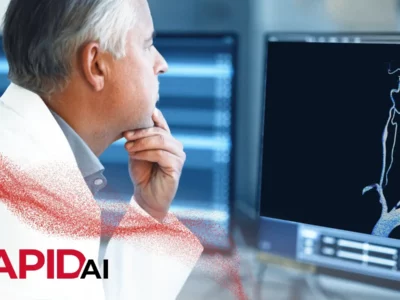
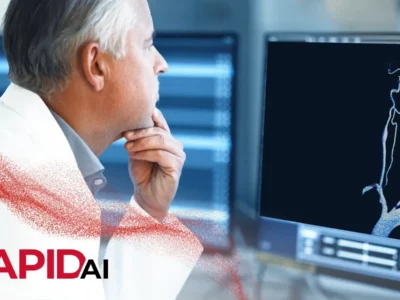
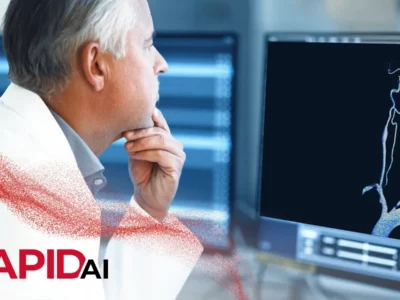
RapidAI, formerly iSchemaView, offers an AI-enabled software platform designed to assist clinicians in assessing medical images. The platform is utilized across various specialties, including neurovascular, cardiac and vascular, and radiology, and is applicable in acute care settings, such as stroke centers, as well as for longer-term patient management.
- What it does: RapidAI’s platform processes and analyzes CT and MR images to provide insights that support clinical decision-making. It goes beyond basic detection to offer quantitative and contextualized information for various conditions.
- Who it is for: The tool is intended for physicians, radiologists, and care teams involved in diagnosing and managing conditions across neurovascular (e.g., ischemic stroke, ICH, aneurysms), cardiac and vascular (e.g., aortic assessment, pulmonary embolism), and general radiology. It aims to support workflows in hospitals and healthcare systems.
- How it fits a clinical or practice workflow: RapidAI integrates with existing hospital systems, including PACS, EHR, and worklist providers, to streamline radiology workflows and facilitate communication among care teams. It can automatically send images for processing and deliver results to PACS, email, and mobile apps. The platform is designed to provide real-time collaboration and alerts for urgent cases.
- Notable capabilities: Key features include deep clinical AI for detailed insights, workflow integration for seamless execution, enterprise infrastructure for scalability and security, and data analytics for performance visibility. Specific modules address neurocritical assessment, ischemic stroke, aneurysm detection and tracking, aortic assessment, and pulmonary embolism detection. The platform also offers Navigator Pro for radiology case prioritization and AI interpretation assistance.
Reviewed by Pouyan Golshani, MD — Interventional Radiologist
Key Features
- AI-enabled medical imaging analysis platform
- Automated processing of CT and MRI images
- Detection of large vessel occlusion (LVO) and intracranial hemorrhage (ICH)
- CT perfusion (CTP) and MR perfusion maps
- CT angiography (CTA) maps and 3D reconstruction
- ASPECTS scoring from CT scans
- Mobile app for real-time notifications and image viewing
- Integration with PACS, email, text, and third-party systems
- Customizable notifications for hospitals and physicians
- Aneurysm and aortic analysis capabilities
Use Cases
- Acute stroke assessment and diagnosis
- Patient triage and clinical decision making in cerebrovascular emergencies
- Selection of patients for mechanical thrombectomy
- Monitoring of cerebral aneurysms
- Detection and monitoring of aortic aneurysms and dissections
- Facilitating communication and collaboration among stroke care teams
What Physicians Need to Know
To maximize the benefits of 'Rapid' (or any similar CDS tool), actively engage with its evidence-based recommendations while always applying your clinical judgment. Provide feedback on alert relevance and timing to help refine the system and reduce alert fatigue. Utilize the differential diagnosis support to broaden your diagnostic considerations and ensure comprehensive patient evaluation. Understand how the tool integrates into your EHR to leverage its full potential within your daily workflow. For specialized areas, be aware that tools like 'RapidAI' exist for specific fields such as vascular medicine, offering deep contextual data and AI-powered insights for faster, life-changing decisions in those domains.
Effective CDS tools are engineered for seamless integration with major Electronic Health Record (EHR) systems (e.g., Epic, Cerner, MEDITECH) to deliver real-time, patient-specific recommendations directly at the point of care. This integration typically involves leveraging existing patient data from the EHR for context-aware insights and feeding back clinician actions and feedback to continuously improve protocols. Advanced systems may consolidate suggestions and alerts from multiple AI and evidence-based CDS tools into a unified dashboard. Crucially, interoperability and high data quality are essential for reliable outcomes and effective communication across care teams.
Details
| Category | Neurology AI, Radiology & Imaging AI |
| Pricing | Contact for pricing — Standard Package: $65,520/year; Perfusion for Existing Site: $14,000; Activation Fee: $7,500 |
| Deployment | On-premise server or cloud-based virtual system |
| Compliance | |
| BAA Available | Unknown AI-estimated |
| HIPAA Compliant | Yes AI-estimated |
| FDA Status |
1 AI-estimated RapidAI has received multiple FDA clearances for its various modules, including Rapid CTA, Rapid ICH, Rapid LVO, Rapid ASPECTS, and Rapid SDH, which assist in the assessment of cerebrovascular diseases like stroke by analyzing CT and MRI images. The company's K232156 for Rapid ASPECTS (v3) was cleared on January 19, 2024. |
| Integrations | |
| EHR | Not specified |
| Specialties | Emergency Medicine, Neurology, Radiology |
What the Web Says
RapidAI is an AI-powered platform primarily designed for stroke and vascular imaging, aiding physicians in the rapid diagnosis and treatment of conditions like stroke, subdural hematomas, and aneurysms. It analyzes brain scans (CT and MRI) and provides results within minutes, integrating with hospital systems via PACS and mobile apps. While it has the potential to improve acute stroke care by creating efficiencies in the diagnostic process, its impact on many important clinical outcomes, such as patient harms, mortality, and quality of life, remains uncertain due to limitations in available evidence.
Overall: MixedStrengths
- Expedites treatment decisions by providing rapid analysis of brain scans (CT and MRI).
- Accurate in detecting intracranial hemorrhages (ICH) and large vessel occlusions (LVO) when combined with clinician interpretation.
- Helps focus radiologists' interpretation to specific regions of anatomy.
- Facilitates transfer of patients requiring more intervention.
- Integrates with existing radiology workflows and systems like PACS.
- Offers mobile alerts for time-sensitive findings and in-app messaging for team coordination.
Limitations
- Impact on patient harms, mortality, quality of life, and length of hospital stay is uncertain due to limited evidence.
- Cost-effectiveness for stroke detection is currently unknown.
- Can be susceptible to motion artifacts and performs poorly with LVO detection in cases of poor contrast boluses.
- May produce false positives, for example, in ICH detection at the falx or dural calcifications.
- Requires radiologist confirmation on every study, as it is not intended for autonomous interpretation.
- Some employee reviews mention a toxic sales culture and horrible executive team.
Based on reviews from: Elion, Indeed.com, Reddit, RapidAI Publications, NCBI Bookshelf, Canada's Drug Agency, SoftFinders, Slashdot
Last updated: 2026-07-21
Ratings & Reviews
No reviews yet. Be the first to review this tool!
Rate Rapid
Press & Coverage
No FAQs available yet for this tool.