VBrain

by Vysioneer  · Based in United States → — As a second set of eyes and hands for clinicians, VBrain maximizes radiotherapy accuracy and speeds up crucial treatment time for patients.
Neurosurgery Oncology Radiology

Contact for pricing
Regulatory Status Disclosed

Overview

VBrain by Vysioneer is an artificial intelligence-powered radiological image processing software designed to assist in radiation therapy treatment planning. The tool provides automated tumor detection and auto-contouring (segmentation) for three common types of brain tumors: brain metastases, meningiomas, and acoustic neuromas.

The software is built for radiation oncologists, neurosurgeons, and medical physicists working in clinical radiotherapy and stereotactic radiosurgery (SRS) settings. It operates on axial T1 contrast-enhanced brain MRI images to generate initial Gross Tumor Volume (GTV) contours for adult patients.

VBrain fits into the clinical workflow as a vendor-neutral, cloud-based solution that integrates with existing treatment planning systems. It acts as an assistive tool, generating fully automated contours within minutes. Clinicians then review, modify, and finalize these contours, which helps standardize treatment planning, reduce manual contouring time, and minimize inter-observer variability.

Reviewed by Pouyan Golshani, MD — Interventional Radiologist

Key Features

  • AI-powered brain tumor auto-contouring
  • Applies to brain metastasis, meningioma, and acoustic neuroma
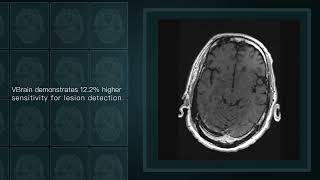
  • Increases lesion detection sensitivity (12.2% higher)
  • Reduces treatment planning time (median 30.8% decrease)
  • Improves contouring accuracy for less experienced clinicians
  • Cloud-based AI platform
  • Vendor-neutral and integrates with treatment planning systems
  • Automated contours generated in one minute
  • Lesion-level precision for drug efficacy evaluation
  • Supports multi-modality image registration

Use Cases

  • Radiotherapy treatment planning for brain tumors
  • Accelerating radiosurgery workflow
  • Enhancing precision in tumor targeting
  • Assisting clinicians in workflow triage
  • Oncology clinical trial development and drug efficacy assessment
  • Improving quality of cancer care

What Physicians Need to Know

Key Capabilities
AI-powered auto-contouring for brain metastases, meningioma, and acoustic neuroma on T1 contrast-enhanced MRI images. Utilizes deep learning neural networks (3D U-Net and DeepMedic) for segmentation.
Clinical Utility
Increases lesion detection sensitivity by 12.2% and decreases treatment planning time by a median of 30.8%. Improves contouring accuracy and reduces inter-observer variation, especially for less experienced clinicians.
Integration Options
Configured to work on a PACS network, pulling patient scans or allowing users to send MR images. Requires an external platform supporting DICOM-RT viewing/editing functions (e.g., image visualization software, treatment planning system) for final contour review and modification.
Compliance Status
FDA cleared in 2021 as the first AI device for tumor auto-contouring in radiation therapy.
Pricing Model
Specific pricing details are not publicly available and typically require direct inquiry with Vysioneer Inc.
User Experience
Designed as an assistive tool to significantly reduce manual contouring time (from hours to minutes), enhancing efficiency and allowing clinicians to focus more on patient care. Improves accuracy for clinicians of all skill levels.
Support Quality
Information regarding specific support quality metrics is not publicly available in the provided search results.
Implementation Complexity
Described as 'clinic-ready' and designed to fit into existing radiation therapy planning workflows by integrating with PACS and DICOM-RT compatible systems, suggesting a streamlined deployment process.
Evidence Base
Validated through an 18-month clinical integration at National Taiwan University Hospital, with results published in *Neuro-Oncology*. A study in a heterogeneous cohort of 100 patients showed 96.23% sensitivity for metastases u22655mm.
Physician Tip

VBrain is an assistive AI tool; physicians must always review and finalize (confirm or modify) the generated contours. It is specifically cleared for brain metastases, meningioma, and acoustic neuroma, and should only be used for these diagnosed tumor types in adult patients. Leverage its efficiency to reduce planning time and enhance detection, but maintain clinical oversight.

VBrain is designed for integration into existing radiation therapy workflows, primarily through PACS networks. Compatibility with DICOM-RT viewing/editing platforms is essential for the physician's review and modification of the AI-generated contours.

Details

Category Oncology AI
Pricing Contact for pricing
DeploymentCloud-based, integrates with PACS and treatment planning systems
Compliance
BAA AvailableUnknown AI-estimated
HIPAA CompliantUnknown AI-estimated
FDA Status 1 AI-estimated

VBrain received FDA clearance (K213628) on December 16, 2021, as the first-ever AI-powered tumor auto-contouring solution for radiation therapy, specifically for brain metastasis, meningioma, and acoustic neuroma.

Integrations
EHR Not specified
Specialties Neurosurgery, Oncology, Radiology

What the Web Says

VBrain by Vysioneer is an AI-powered tumor autocontouring software that received FDA clearance in 2021, touted as the first of its kind for radiation therapy. It is designed to assist clinicians in more accurately and efficiently contouring brain tumors for radiation treatment planning, specifically for brain metastasis, meningioma, and acoustic neuroma. Clinical studies have indicated that VBrain improves lesion detection sensitivity, enhances contouring accuracy for less experienced clinicians, and significantly reduces treatment planning time.

Overall: Positive

Strengths

  • Increased accuracy and sensitivity in lesion detection (12.2% higher sensitivity).
  • Improved contouring accuracy, especially for less experienced clinicians.
  • Reduced treatment planning time (median of 30.8%).
  • Fully automated contouring, reducing manual effort from hours to minutes.
  • Vendor-neutral and seamlessly integrates with existing treatment planning systems.
  • Cloud-based software with potential for global impact, even in resource-limited areas.

Limitations

  • Cannot replace the expertise of the treating physician; contours must be reviewed and modified.
  • Intended only for specific brain tumor types (brain metastasis, meningioma, acoustic neuroma) and adult patients.
  • Not intended for tumor detection or diagnosis; users must know the tumor type.
  • Limited information available from independent tech reviewers, Reddit, G2, or Capterra.

Based on reviews from: Bioworld, VYSIONEER (Official Website), Med-Tech News, PMC (Neuro-Oncology Journal), PR Newswire, accessdata.fda.gov, Imaging Technology News, NeuroNews, Princeton Innovation

Last updated: 2026-07-20

Ratings & Reviews

No reviews yet. Be the first to review this tool!

Rate VBrain

Clinical Value
Ease of Use
Integration
Support & Docs
Value for Money

Press & Coverage

PR Newswire
VYSIONEER Collaborates with MC Medical to Introduce the First-ever Brain Tumor Auto Contouring AI for Radiotherapy to Japan
Vysioneer has partnered with MC Medical to bring its VBrain AI solution for brain tumor auto-contouring to the Japanese market, aiming to improve clinical workflows and treatment accuracy for brain radiosurgery and radiotherapy.
2024-01
MDPI
Advancing Brain Tumor Analysis: Current Trends, Key Challenges, and Perspectives in Deep Learning-Based Brain MRI Tumor Diagnosis
This article highlights the FDA's clearance of Vysioneer's VBrain as a significant milestone in AI adoption for brain tumor diagnosis and treatment planning, noting its role in enhancing precision in radiology and neurosurgery.
2025-04
PMC (Neuro-Oncology Advances)
Stratified assessment of an FDA-cleared deep learning algorithm for automated detection and contouring of metastatic brain tumors in stereotactic radiosurgery
This study assesses the performance of Vysioneer's FDA-cleared VBrain deep learning algorithm for automated detection and contouring of metastatic brain tumors in stereotactic radiosurgery, showing promising results with high sensitivity for lesions 5mm or larger.
2023-04
British Journal of Radiology
Artificial intelligence in neuroradiology: a review of Food and Drug Administration-regulated algorithms
This review of FDA-regulated AI algorithms in neuroradiology mentions VBrain by Vysioneer Inc. as an example of an AI tool that demonstrated 96.2% sensitivity for detecting brain metastases u22655 mm.
2026-05
Business Wire
GE Healthcare Advances the Future of Precision Medicine in Oncology with New Technology Partners at #ASCO22
GE Healthcare announced its collaboration with Vysioneer to utilize VBrain, an FDA-cleared AI solution for auto-contouring of brain tumors, to enhance precision in radiotherapy treatment planning.
2022-06
BioWorld
FDA gives green light to Vysioneer's brain tumor autocontouring tool
Vysioneer received FDA clearance for its VBrain artificial intelligence (AI)-powered tumor autocontouring software, making it the first AI device to receive such clearance for tumor autocontouring in radiation therapy.
2021-04
PR Newswire
Vysioneer Receives FDA Clearance on First-Ever Tumor Auto-Contouring Solution for Radiation Therapy
Vysioneer announced FDA clearance for VBrain, an AI-powered tumor auto-contouring solution designed to maximize radiotherapy accuracy and speed up treatment time for brain metastasis, meningioma, and acoustic neuroma.
2021-04
NS Medical Devices
Vysioneer gets FDA nod for VBrain AI-based tumour auto-contouring
Vysioneer secured FDA approval for VBrain, an AI-powered tumor auto-contouring solution for radiation therapy, which is claimed to be the first AI device of its kind for tumor auto-contouring.
2021-04

Videos

Product demos, reviews, and walkthroughs for VBrain.

View all on YouTube

Frequently Asked Questions

VBrain is designed for seamless integration with most major Electronic Medical Record (EMR) systems, often through standard APIs, to minimize disruption. It aims to provide AI-driven insights directly within the physician's existing workflow, supporting tasks like treatment planning and clinical decision-making.
VBrain holds relevant regulatory approvals, such as FDA clearance for its intended use in oncology, ensuring its safety and efficacy. It adheres to strict data privacy regulations like HIPAA and GDPR, implementing safeguards such as data encryption and access controls to secure patient information.
VBrain employs rigorous validation processes and diverse training datasets to mitigate algorithmic bias, continuously monitoring its performance across various patient demographics. Regular updates are deployed to enhance fairness and accuracy in its oncology recommendations, acknowledging that biases can arise from unrepresentative data.
VBrain typically offers tiered subscription models, which may include per-user, per-patient, or usage-based fees, with discounts often available for multi-year commitments. Specific packages are designed to accommodate the needs and budgets of both large institutions and smaller oncology practices, though complex AI solutions can have significant development and implementation costs.
While VBrain provides powerful analytical support, it is an assistive tool and not a substitute for clinical judgment; its recommendations should always be interpreted by a qualified oncologist. Limitations may include dependencies on data quality, the 'black box' nature of some AI decisions, and challenges in generalizability to rare cancer types or specific patient scenarios.
VBrain differentiates itself through its specialized focus on [specific aspect, e.g., genomic-driven treatment pathways or real-time predictive analytics] and its robust integration capabilities. It aims to offer a unique blend of comprehensive data analysis and a user-friendly interface tailored for oncology, similar to other platforms like IBM Watson for Oncology or Tempus.

Related Tools

Surgical Reality Viewer
Surgical Reality
Oncology AI
Surgical Reality offers CE- and FDA-certified AI-powered 3D medical imaging and surgical planning software that transforms CT scans into patient-specific 3D models for thoracic surgery, enhancing precision in complex lung procedures.
Cancer Copilot
Color Health
Oncology AI
Color Health's Cancer Copilot, built with OpenAI, helps oncologists and clinicians identify and order workup needs for recently diagnosed patients, aiming to speed up time to cancer treatment. This AI tool is designed to expand cancer expertise, speed decisions, and improve care, reducing a two-hour clinical task to 10 minutes with over 95% validated accuracy.
Cercare Medical Oncology Virtual Expert
Cercare Medical
Neurology AI
Cercare Medical's Oncology Virtual Expert is an AI-powered brain tumor segmentation module that provides fast, consistent, and semi-automated tumor analysis from standard MRI data, designed for on-premise deployment within existing clinical radiology workflows.
Synapse Lung Nodule AI
Fujifilm Corporation
Oncology AI
Fujifilm's Synapse Lung Nodule AI is an AI software algorithm for detecting pulmonary nodules on CT imaging, aiming to support early detection and treatment of lung cancer.
RadOncAI
Informai (for RadOncAI product) / Global Network for AI in Radiation Oncology (for RadoncAI.net)
Oncology AI
RadOncAI is an AI solution by Informai designed to optimize and enhance radiation oncology workflows, improving efficiency and accuracy in treatment planning and delivery.
FAITH project (Fatigue Therapy – AI-supported Diagnosis and Therapy of Tumour-associated Fatigue Syndrome)
Fimo Health GmbH (Consortium Leader)
Mental & Behavioral Health AI
The FAITH project is developing an AI-based solution for the diagnosis and therapy of tumor-associated fatigue syndrome in cancer patients. It uses wearable sensors, a smartphone app, and artificial intelligence to provide individualized therapy recommendations and monitor mental health.

See all Oncology AI tools →

More from Vysioneer

VBrain-OAR
Vysioneer
Neurology AI
VBrain-OAR by Vysioneer is an FDA-cleared AI software for automated contouring of organs at risk (OAR) in brain MRI images and multi-modality image registration, designed to assist in radiation treatment planning.

View company profile →

Suggest an Edit → | Last Verified: 2026-04-19 | First Added: 2026-04-19
AI Tool Finder
AI-powered search. Results may not be comprehensive.